Foot Care for Long Rucks and Multi-Day Hikes: Hot-Spot Drills, Blister Taping, Sock Systems, and Field Treatment
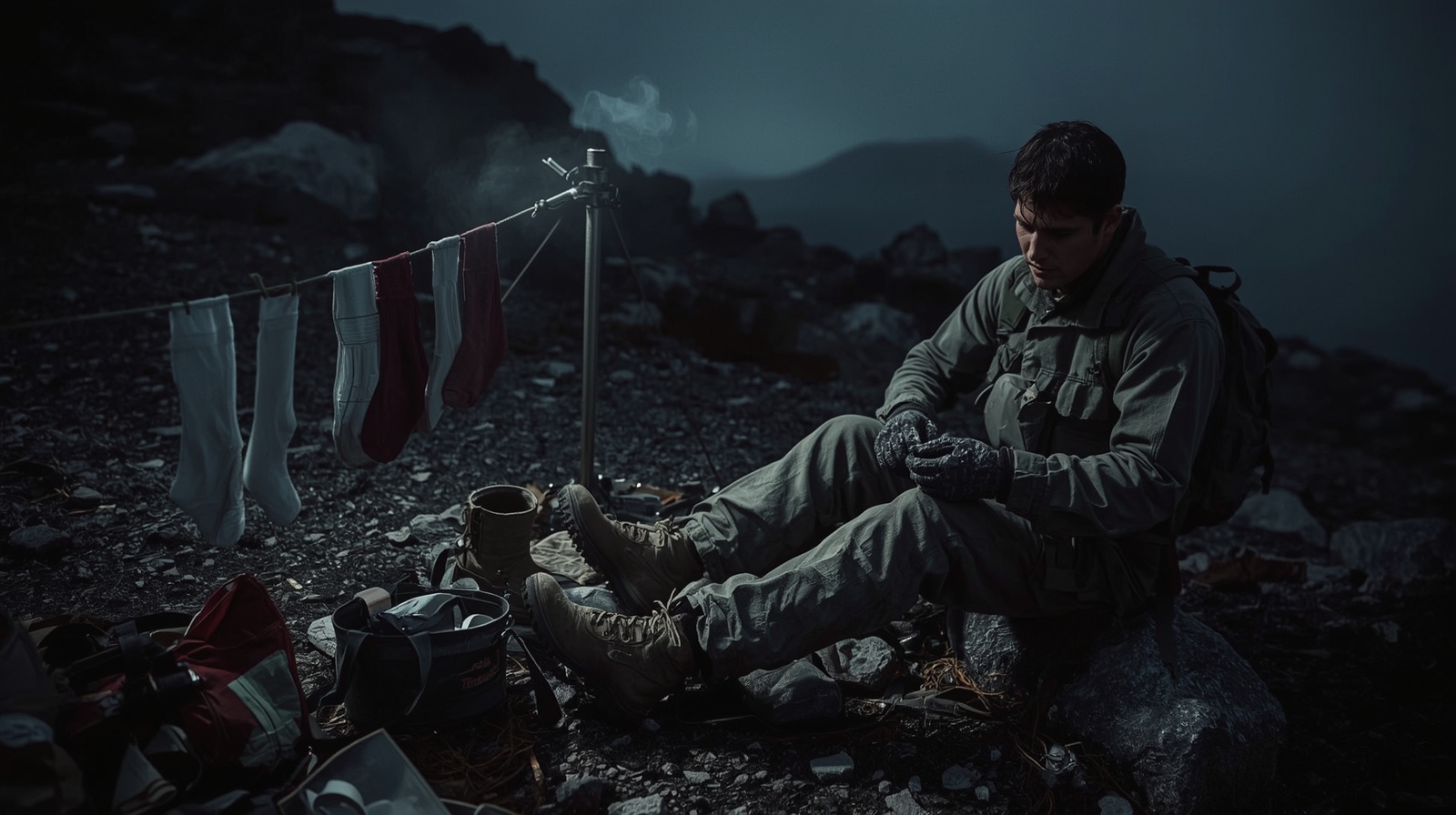
Why feet fail on long rucks (and why “toughness” doesn’t fix it)
Long distance under load doesn’t destroy feet because you’re weak. It breaks feet down because friction, moisture, heat, and pressure stack up for hours without a reset.
In military movement, you learn fast that discipline beats motivation. Foot care is the same way. A boring routine done early prevents a dramatic problem later.
When you’re carrying a pack, your stride changes. You land heavier, your ankles work harder, and your foot slides more inside the boot-especially on descents.
Add sweat, stream crossings, and grit, and you’ve got a perfect abrasive environment. If you wait until pain is sharp, you’ve already missed the easy window.
Friction, shear, and the “hot spot timeline”
A hot spot isn’t a blister yet. It’s an early warning that shear is happening: the top layers of skin are being pulled in one direction while deeper layers stay put.
Fluid builds between those layers, and now you’ve got a blister. That’s the mechanical reality, not bad luck.
The timeline matters. Early on, you feel warmth or a mild burn. Later, it becomes a focused sting, and your foot starts to compensate.
Common compensation patterns look like this:
- Shorter stride
- Toe-out walking
- Heel-avoidance
That gait change is where secondary injuries come from. Fixing friction early is faster than managing a blister for the next 30 miles.
Moisture management is injury prevention
Wet skin softens and wrinkles, which makes it easier to tear. This is maceration-your skin turns pale and pruney and loses durability.
Macerated feet blister faster and heal slower. They also tend to split and crack, which creates its own set of problems.
If you take one lesson from wet-weather training, let it be this: you don’t need perfectly dry feet to stay functional. You do need controlled moisture.
That usually means:
- Sock changes at planned intervals
- Smart venting during short halts
- Quick drying when you can (even if it’s imperfect)
Load, terrain, and downhill are force multipliers
Most people blame their boots when the real problem is downhill mechanics. Descents drive your foot forward, smash your toes, and increase heel slip unless your lacing and sizing are dialed.
Loose terrain adds micro-slips with every step. Those tiny slides don’t feel dramatic, but they grind skin for hours.
If you regularly hike scree or talus, revisit your movement habits and foot placement. Pairing good foot care with safer movement pays off, especially on long trips.
If your routes include unstable ground, review traveling safely on loose terrain to reduce the constant sliding that chews up skin.
Transitioning from “why it happens” to “what to do,” the next section gives you a simple drill you can run on the move.
Hot-spot drills: the 90-second routine that prevents 90% of blisters
Hot-spot drills are not a “maybe later” task. They’re a standard operating procedure you run during short halts, before pain becomes damage.
The goal is to catch friction while it’s still reversible. You’re trying to stay ahead of the problem, not win a pain contest.
A simple rule works well in the field:
- If you feel heat, stop within 10 minutes.
- If you feel burning, stop immediately.
You don’t need a long break. You just need enough time to inspect and correct.
The 90-second check (what you look for)
Take a knee and loosen the boot. Pull the sock down just enough to inspect the suspected area.
You’re looking for early indicators:
- Redness
- Shiny skin
- A “tight” feeling in a small patch
If the skin is intact but irritated, you’re still in the easy-fix stage.
Also check the sock itself. If it’s bunched, twisted, or gritty, that’s the culprit more often than your boot.
Finally, run your fingers inside the boot around the heel cup and toe box. Sand and small debris are silent blister-makers.
Immediate corrections: lacing, sock reset, and friction barriers
If the heel is slipping, re-lace with a heel lock (runner’s loop). Then snug the ankle zone before tightening the top.
If your toes are getting hammered downhill, loosen the forefoot slightly and tighten the midfoot. The goal is to keep the foot from sliding forward under load.
Reset the sock so it lays flat with no wrinkles. If you have a liner, make sure the liner and outer sock aren’t “fighting” each other with folds in the same spot.
If the hot spot persists, apply a friction barrier (tape or a blister patch) right then. Waiting until the next stop is how you “earn” a blister.
Planned halts: build foot checks into your movement plan
On multi-day hikes, schedule foot checks like you schedule water. A solid baseline is every 60-90 minutes, plus any time terrain shifts.
Good triggers include:
- Long descent
- Long climb
- Extended wet section
- Any time you feel rubbing or heat
Heat and sweat accelerate failure. If you’re operating in high temperatures, treat foot care as part of your heat plan.
The same discipline that prevents heat casualties also prevents foot breakdown. For hot-weather pacing and cooling strategy that complements foot routines, reference heat illness prevention in the field.
Quick rule: If a hot spot is noticeable while walking, it’s already urgent. Stop early, fix it fast, and you’ll usually lose less than two minutes.
Now that you’ve got a drill for catching problems early, you’ll get more mileage from it if your boot fit and lacing are actually supporting the plan.
Boot fit and lacing: solving the cause instead of taping the symptom
Taping is important, but it’s not a substitute for fit. If your boot is wrong for your foot shape-or your lacing is sloppy-you’ll be taping all day and still losing skin.
Your goal is to reduce internal movement without cutting off circulation. That balance is what keeps you functional over multiple days.
Boot fit for long rucks is different than casual hiking. You need room for swelling, but not so much volume that your heel floats.
You also need a stable midfoot, a secure heel, and toe space for descents.
Sizing for swelling and descent (the reality check)
On day two or three of a trip, your feet may be a half-size “bigger” from swelling. If your boots only fit perfectly on day one, they’re likely too small.
At the same time, oversized boots create slide. And slide creates blisters.
Use a practical test: with boots laced for movement, your heel should lift minimally, and your toes should not slam the front when walking downhill.
If you routinely get black toenails, that’s almost always a fit/lacing issue. Fix it before your next trip, because toenails can become a mobility problem-not just a cosmetic one.
Lacing patterns that actually change friction
Most people tighten from the toe up and call it good. Instead, think in zones:
- Forefoot (comfort)
- Midfoot (lockdown)
- Ankle (stability)
- Cuff (blood flow)
Use a heel lock for heel blisters. Use window lacing to relieve pressure over a sore instep.
On steep descents, re-lace at the top of the hill. It’s easier to prevent slide than to recover from it after your toes have been pounding for an hour.
Insoles and volume management (simple but overlooked)
If your boot has too much volume, your foot swims. If it has too little, you create pressure points.
Insoles and volume spacers can help, but they’re not magic. They’re tools for fine-tuning.
A supportive insole can reduce internal slide by stabilizing the arch and heel. The key is testing under load, not on a store floor.
Put your full pack on, walk a hill, and see what changes. If it only works in the living room, it doesn’t work.
Once boot fit is handled, socks become your primary lever for moisture and friction control.
Sock systems that work: liner vs single-layer, wool vs synthetic, and rotation plans
Socks are your interface layer. They manage moisture, reduce friction, and protect skin.
On long movements, the sock system matters as much as the boot. And a “sock system” isn’t just what you wear-it’s also your routine.
That includes when you change socks, how you dry them, and what you sleep in. You don’t need a huge sock collection, but you do need a method.
Liner socks vs single-layer: what changes and when to use them
A liner sock adds a sacrificial friction layer. The idea is that the liner slides against the outer sock instead of your skin sliding against fabric.
This can help if you blister easily or you have known hot-spot zones.
Single-layer socks can be simpler and cooler, especially in hot climates. The tradeoff is that your skin becomes the friction surface unless the sock fabric and fit are perfect.
If you choose liners, keep them thin and tight. Loose liners wrinkle, and wrinkles are blister factories.
Material choices (wool, synthetic, blends) and the real tradeoffs
Merino wool blends handle odor and temperature swings well. They also insulate even when damp, which matters on cold mornings and wet days.
Synthetics often dry faster and can feel smoother against the skin. For some hikers, that smoother feel reduces rubbing.
The wrong move is chasing a label instead of performance. What matters is fit, seam placement, and how the sock behaves after four hours of sweat.
Test your socks on training rucks, not on your “big trip.” If they fail on a 6-mile shakeout, you just saved yourself a long, painful week.
A practical sock rotation plan for multi-day movement
You want three sock states:
- One on your feet
- One drying on your pack
- One reserved for sleeping
Your sleep socks are your recovery tool. They let your skin dry and normalize overnight.
During the day, change socks when they’re saturated or when grit gets inside. In persistent wet conditions, you may not achieve “dry,” but you can still swap to reduce grit and manage maceration.
Here’s a quick comparison that keeps decisions simple:
| System | Pros | Cons | Best Use |
|---|---|---|---|
| Thin liner + medium outer | Reduces shear, good for blister-prone feet | Hotter, more laundry/drying | Long rucks, multi-day, downhill-heavy |
| Single medium wool blend | Simple, warm when damp | Can hold moisture longer | Variable temps, moderate pace |
| Single synthetic hiking sock | Dries fast, often smoother | Odor, can feel slick in boots | Hot climates, frequent stream crossings |
With your socks sorted, the next skill is making tape stay put when everything is sweaty, gritty, and moving.
Blister taping that stays put: hot spots, heel cups, toes, and Achilles
Taping is a skill, not a product. If your tape peels after 30 minutes, it’s usually technique.
Common causes include:
- Dirty or oily skin
- Corners not rounded
- Wrong tension
- Tape bridging a high-movement area
For long rucks, you want tape that bonds strongly and resists sweat. Many people use Leukotape P or similar rigid sports tape.
Kinesiology tape is flexible and comfortable, but it often fails sooner under heavy moisture and grit.
Skin prep: the step most people skip
Tape sticks to clean, dry skin. That means wiping sweat and oils off first.
If you have an alcohol pad, use it. Then let the skin dry fully before taping.
If the area is hairy (top of foot, ankle), consider trimming hair before trips. In the field, ripping tape off aggressively can take skin with it.
If you’re applying tape to damp skin, you’re gambling. Sometimes it works, but it’s not a reliable system.
Hot-spot taping (flat areas) vs blister-prone curves (heels)
For a flat hot spot, apply a single layer with no tension. Smooth from the center outward so you don’t trap wrinkles.
Round all corners so the tape doesn’t catch and peel.
For heels, use overlapping strips like shingles. Start slightly below the heel and work upward.
This creates a durable heel cup that resists edge lifting. Keep the ankle flex point free when possible; tape that crosses a hinge point tends to roll.
Toe protection and interdigital hotspots
Toe blisters often come from toe smash (boot fit) or toe-on-toe rubbing (foot shape and sock fit).
For toe tips, a small cap of tape can help. Just make sure your toe box has room, or you’ll trade blister protection for pressure.
Between toes, tape is tough to keep in place. A better approach is:
- Toe socks
- A small dab of anti-chafe product
- A thin strip placed carefully with the toes spread, then relaxed
Tape reality: Tape is there to buy you time and protect skin. If you keep generating new hot spots every hour, you need to fix fit, socks, or moisture-not add more tape.
Even with good prevention, blisters can still happen. The next section is about handling them without turning a small issue into an evacuation problem.
Blister treatment in the field: drain, protect, and prevent infection
Not every blister needs to be drained. The decision depends on location, size, pain, and whether it interferes with movement.
In operational settings, the goal is function with acceptable risk. In backcountry settings, the goal is function without creating an infection miles from help.
If you’re immunocompromised, diabetic, or have circulation issues, be more conservative. Consider medical guidance before extended trips.
When to leave it alone vs when to drain
If a blister is small and not painful, leave it intact. Protect it with tape or a blister dressing.
The roof is your best natural barrier. If you can keep it intact, you usually recover faster.
If it’s large, painful, or in a high-pressure zone (heel edge, ball of foot) where it’s likely to pop on its own, controlled drainage can reduce pain and prevent a messy tear.
If the blister is filled with blood (a blood blister), treat it carefully. These can indicate deeper tissue damage. Drainage is more complex, and protection becomes the priority.
Controlled drainage: clean technique, minimal trauma
If you choose to drain, start clean and stay clean. You’re making a small wound on purpose, so the hygiene standard needs to be higher than “good enough.”
A practical, low-drama process looks like this:
- Wash or sanitize your hands.
- Clean the blister surface (alcohol pad if available).
- Use a sterilized needle (or a clean safety pin heated, then cooled).
- Puncture near the edge, not the center.
- Gently express fluid using clean gauze or a clean cloth.
- Leave the blister roof in place.
After draining, protect the area so it doesn’t shear again. A simple approach is a “donut” pad (moleskin/foam) around the blister, then tape over it to hold everything in place.
Finally, reassess your system. A drained blister that keeps refilling is a signal: something is still rubbing, still sliding, or staying too wet.