
How to Audit and Winterize Your Tactical Gear Cache Before an Economic Disruption Makes Resupply Unreliable
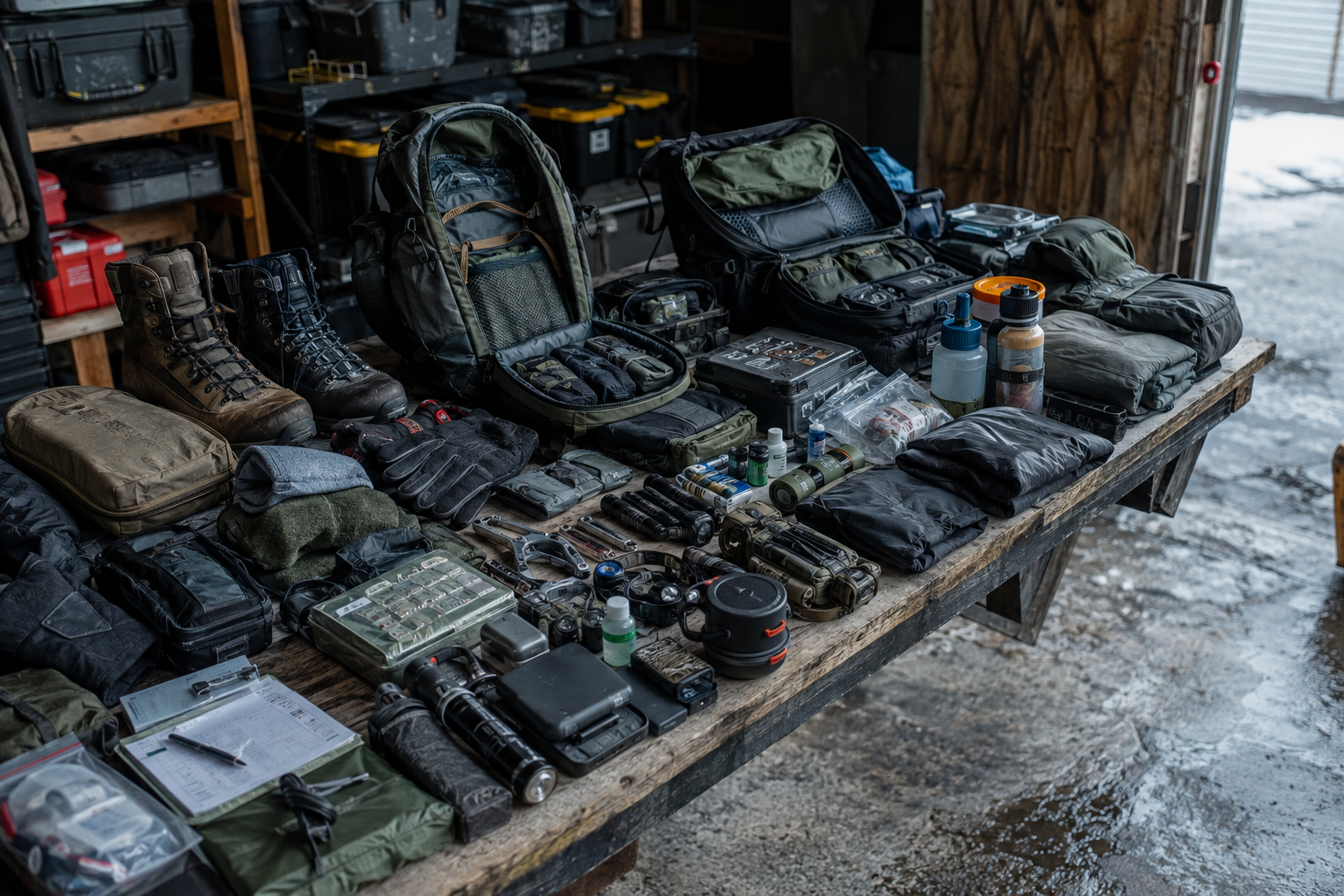
Introduction: Gear Audit Protocol
Start with what you own. A structured gear audit is the highest-return action you can take before supply chain pressure raises prices or pulls inventory. This is a gap analysis with a procurement deadline. The process runs four stages: Inventory Documentation, Condition Assessment, Cold-Weather Capability Mapping, and Prioritized Procurement.
Stage 1: Build a Complete Inventory Before You Evaluate Anything
Pull everything out of storage — packs, layering systems, shelter components, footwear, gloves, headwear, and accessories — and document it in a single spreadsheet with columns for item name, quantity, age, last use, and storage location before assessing condition. Then divide items into three tiers: everyday carry, 72-hour kit, and extended-operation cache. A cold-weather gap in your 72-hour kit is higher priority than the same gap in your extended cache.
- Consumables: Hand warmers, boot waterproofing compound, seam sealer, and repair patches deplete and expire. Flag expired items for immediate replacement.
- Storage conditions: Gear stored compressed — down insulation especially — loses loft and thermal performance. Flag compressed insulation for priority inspection.
- Operational tier: Assign each item to its tier before prioritizing spending on gaps.
Stage 2: Condition Assessment by Failure Mode
Gear degrades in predictable ways. Organize your condition assessment around how each category fails under cold-weather stress, and work through every failure mode before returning any item to your cache.
Six Core Failure Modes
Failure Mode 01 — Shell & Outer Layer Delamination. Waterproof-breathable membranes delaminate after repeated compression, heat exposure, or improper storage, and the failure is invisible until the garment is wet. Run water over the outer face — beading indicates active DWR, sheeting indicates failure. Flex fabric at seams and corners; crackling or visible separation means delamination — retire the shell. Press along taped seams; lifting edges mean seam integrity is gone. Inspect underarm and shoulder zones first.
Failure Mode 02 — Insulation Loft Loss. Down and synthetic insulation lose thermal efficiency through compression, moisture absorption, and baffle degradation. Shake out the garment, hang it 24 hours, then pinch each baffle — it should spring back with noticeable loft; flat or slow-recovering baffles indicate degraded fill. A musty odor indicates moisture damage to down, permanently reducing efficiency. Synthetic insulation that has pilled or matted internally will not recover and must be replaced.
Failure Mode 03 — Footwear Sole Delamination & Midsole Compression. Polyurethane midsoles undergo hydrolysis — chemical breakdown accelerated by humidity and temperature cycling — even in unworn boots. Flex the sole sharply at the toe box and heel; cracking or powdering indicates hydrolysis and the boot is unsafe. Press the midsole — easy compression with no rebound means lost structural integrity. Run a finger along the outsole-to-upper bond; any lifting requires repair before cold-weather use. Check lug depth, as worn lugs reduce traction on ice and packed snow.
Failure Mode 04 — Load-Bearing Hardware & Webbing Fatigue. Webbing degrades from UV exposure, chemical contact, and load cycling. Flex all webbing sharply — stiff, brittle, or fraying webbing has lost tensile strength; replace any strap showing surface cracking or fiber separation. Load-test every buckle with firm hand pressure; any buckle that slips, clicks unevenly, or shows cracking fails the audit. Inspect stitching at shoulder straps, hip belt anchors, and MOLLE loops. Pitting on metal hardware compromises rated load capacity.
Failure Mode 05 — Shelter System Seam & Pole Failure. Shelter fabrics lose seam tape adhesion over time, and aluminum pole sections develop stress fractures at ferrule joints. Pitch the shelter fully and run a wet finger along every taped seam under tension — any weeping requires resealing. Flex each pole section at the ferrule joint; cracking sounds or visible stress marks require section replacement. Test shock cord tension and replace any guy-line cord showing surface fuzz, stiffness, or discoloration.
Failure Mode 06 — Glove & Handwear System Gaps. Single-layer glove systems fail in sustained cold because they cannot be adjusted for activity level. Verify you have a layered system — at minimum a liner glove plus an insulated outer glove or mitten; for severe cold, add a waterproof over-mitt. Any missing layer is a capability gap — source it now. Check wrist closures and cuff Velcro for adhesion. Inspect palm reinforcement for wear-through and test liner gloves for moisture-wicking performance, as worn liner material that holds moisture accelerates heat loss.
Any item that fails a single assessment point in its failure mode category is flagged for repair or replacement before it re-enters the cache.
Insulation Systems
For down fill, shake out the garment and set it flat — loft should return within 60–90 seconds. Press each baffle panel individually; a healthy baffle feels uniformly puffy with no hard ridges. Flat sections that do not recover should be pulled from rotation or limited to dry, low-wind roles only.
For synthetic fill, run your palm across the garment in long strokes. Thin patches, stiff zones, or areas where fill has migrated indicate delamination that will not recover. Stiff or thin panels in a primary layer must be replaced before the first hard freeze.
DWR Failure: The Hidden Temperature Rating Drop
When DWR degrades, water soaks into the outer fabric — called wetting out — and even an intact membrane beneath loses significant effective insulation value in wet conditions. Sprinkle water on the outer surface: healthy DWR produces tight beads that roll off; wetting out causes the fabric to darken and absorb water. A tumble dryer pass on low heat can restore partially degraded coatings. If beading does not return after two drying cycles, apply a spray-on DWR treatment to the clean, damp surface and heat-set per the product label. If the face fabric continues to wet out after treatment, demote the item to dry-condition-only use.
Waterproof-Breathable Membranes
Seam tape delamination is the most common failure point in gear older than 3–5 seasons. Press firmly along interior seam tape from collar to hem; tape that lifts or bubbles has lost adhesion. Minor delamination on short runs may be field-repairable with seam sealer — follow manufacturer instructions for surface prep and cure time. Extensive or multi-seam delamination means retiring the item from wet-cold operations.
Panel delamination is irreversible. Hold the shell up to light and flex the panel between both hands. A crackling sound, visible layer separation, or brittle feel indicates membrane failure. Retain the item for dry-cold or wind-only use only.
Footwear and Boot Systems
- Midsole compression test: Press your thumb firmly into the midsole at the heel and forefoot. A healthy midsole resists compression and rebounds immediately; easy compression that stays depressed means the foam has lost cushioning and insulation value.
- Welt and upper-to-sole bond: Flex the boot sharply at the toe box and run your thumbnail along the welt seam. Any separation or lifting indicates adhesive failure — cold temperatures accelerate delamination that may not appear in a warm garage.
- Waterproof liner integrity: Fill each boot with water to the ankle line, hold for 60 seconds, and watch the exterior for seepage while rotating and flexing the toe box, as leaks often appear at the toe box or lower welt.
- Insulated liner inspection: Remove liners completely. Flat, matted, or stiff liner insulation has lost thermal efficiency and will not recover. Check for mildew odor and mold. Air-dry liners fully and store them separately from the shell during long-term cache storage.
Layering Base and Mid Layers
Merino wool base layers degrade at high-friction zones first. Run your fingers across shoulders, elbows, and collar — thinning here collapses the insulating air pocket exactly where pack straps create the most heat loss. Stretch the fabric and release it; if it does not snap back cleanly, moisture-wicking performance is already reduced.
Fleece mid layers pill with normal use, but pilling alone is not a failure indicator. What matters is whether the pile has thinned or worn through at stress points — underarms, back panel, and cuffs. A heavily pilled fleece with intact pile thickness still insulates; a lightly pilled fleece with worn-through panels does not.
| Mid-Layer Weight | Effective Range | Typical Use Case | Audit Flag |
|---|---|---|---|
| 100-weight fleece | 40°F – 55°F | Active movement, mild shoulder-season temps | ✓ ACTIVE LAYER |
| 200-weight fleece | 25°F – 45°F | General cold-weather mid layer, stationary work | ✓ CORE LAYER |
| 300-weight fleece | 10°F – 30°F | Extreme cold, camp layer, under hard shell | ✓ COLD LAYER |
| No mid layer in range | Any gap zone | Relying on outer shell alone for insulation | ⚠ COVERAGE GAP |
Stage 3: Cold-Weather Capability Mapping
Map your kit against a realistic cold-weather scenario. Rate each capability as covered, marginal, or absent. Treat marginal items in critical (◈) categories as absent for procurement planning.
| Capability | Minimum Requirement | Gap Indicator |
|---|---|---|
| Core Insulation ◈ | Insulated jacket rated to your coldest expected temp with intact loft | No insulated outer layer or failed loft test |
| Precipitation Protection | Waterproof shell with intact seam tape and functional DWR | Failed membrane or no waterproof layer |
| Hand Protection ◈ | Liner glove plus insulated outer glove or mitten; waterproof over-mitt for severe cold | Single-layer gloves or damaged seams |
| Head & Face Coverage | Insulated hat plus balaclava or face gaiter | No face protection in kit |
| Insulated Footwear ◈ | Boots rated to expected low with intact waterproofing | Three-season boots or failed waterproofing |
| Sleeping System | Bag or quilt rated below expected overnight low; verify EN/ISO rating | Summer-rated bag or compressed insulation |
| Ground Insulation | Pad with R-value appropriate for ground temperature | Foam pad below R-4 or no pad |
| Emergency Thermal Reserve | Emergency bivy or survival-rated space blanket in 72-hour kit | No backup thermal layer |
Stage 4: Prioritized Procurement Against Supply Chain Risk
Prioritize procurement on two axes: operational criticality (how quickly does a gap become a life-safety issue) and supply chain vulnerability (how likely is the item to become unavailable or more expensive under import disruption).
High Priority: Address Before Disruption
Insulated Tactical Jackets & Cold-Weather Shells
Most are manufactured overseas and directly exposed to tariff volatility. If your insulation assessment flagged a failed or marginal outer layer, this is your first buy. Prioritize jackets with a waterproof shell and a removable insulated liner — that modular configuration closes multiple capability gaps with one purchase.
Selection rule: Shell must be waterproof-rated, not just water-resistant. Liner must detach fully for use as a standalone mid-layer.
Cold-Weather Glove Systems
Gloves are low-cost relative to their operational consequence and among the first items to go out of stock during cold snaps. Prioritize wrist cinch closures and reinforced palm panels. Stock a minimum of two complete layered systems — gloves are lost, soaked, or damaged faster than any other extremity protection.
Insulated Boot Liners & Waterproofing Consumables
Boot waterproofing compound, seam sealer, and replacement laces are low-cost insurance items rarely stocked in depth at local retailers. Stock enough for one full season of maintenance. Date-label all opened containers and rotate within the period specified on the product label.
Medium Priority: Address Within 60 Days
Sleeping Bag Upgrade or Liner
If your bag is rated to 20°F or below, a quality liner can extend its warmth adequately. If it is rated above 20°F and you expect winter field use, replace the bag outright — a dedicated winter bag is the more reliable long-term solution.
Cold-Weather Base Layer Redundancy
One set of base layers is a single point of failure. Maintain two full sets (top and bottom) in cold-weather weight — merino wool preferred for odor resistance on extended operations.
Lower Priority: Address When Practical
Shelter Systems
Four-season tents and snow-rated tarps have a relatively stable supply market. If your current shelter handles expected conditions, there is no urgency. Do not defer high-priority insulation purchases to fund shelter upgrades. Monitor pricing quarterly.
Navigation & Signaling Redundancy
Battery-dependent devices lose capacity faster in cold; lithium cells outperform alkaline in sub-freezing temps. A backup compass, paper map set, and non-electronic signaling device cover cold-weather failure modes. Carry lithium cells, store spares at body temperature, and verify analog backups are in the cache before winter.
Storage and Cache Organization After the Audit
- Store Insulation Uncompressed. Keep insulated jackets and mid-layers in breathable stuff sacks or hung loosely — never vacuum-sealed. Sustained compression collapses loft and degrades thermal performance.
- Stage Your 72-Hour Cold-Weather Kit as a Single Unit. Base layer, mid-layer, shell, gloves, hat, and socks should live together as one grab-ready module, not scattered individual items.
- Label Containers by Tier and Season. Mark every container with its tier (72-hour, extended, reserve) and season rating so contents are identifiable without opening it.
- Co-Locate Consumables With the Gear They Service. Waterproofing treatments, seam sealer, and patch kits belong in the same container as the gear they maintain.
Treating Gear Investment as Financial Hedging
Cold-weather tactical gear purchased now hedges against two compounding risks: supply disruption that removes the option to buy at all, and price inflation that makes the same item cost more later. Items with complex overseas manufacturing chains or specialized materials carry higher procurement risk than domestically produced alternatives. Include replacement cost and future availability alongside current price when deciding whether to close a gap now or wait.
// DECISION FILTER — Does closing it now deliver immediate operational value? Does it involve overseas production or specialized materials that raise sourcing risk? Would a meaningful price increase affect affordability later? Items scoring yes on all three are immediate procurement targets.
Rank gaps by combined operational value and procurement risk. The audit is only complete when open gaps have a closure date attached — not when the inventory spreadsheet is finished.