How to Build a 72-Hour Urban Bug-Out Bag for Economic Collapse Scenarios
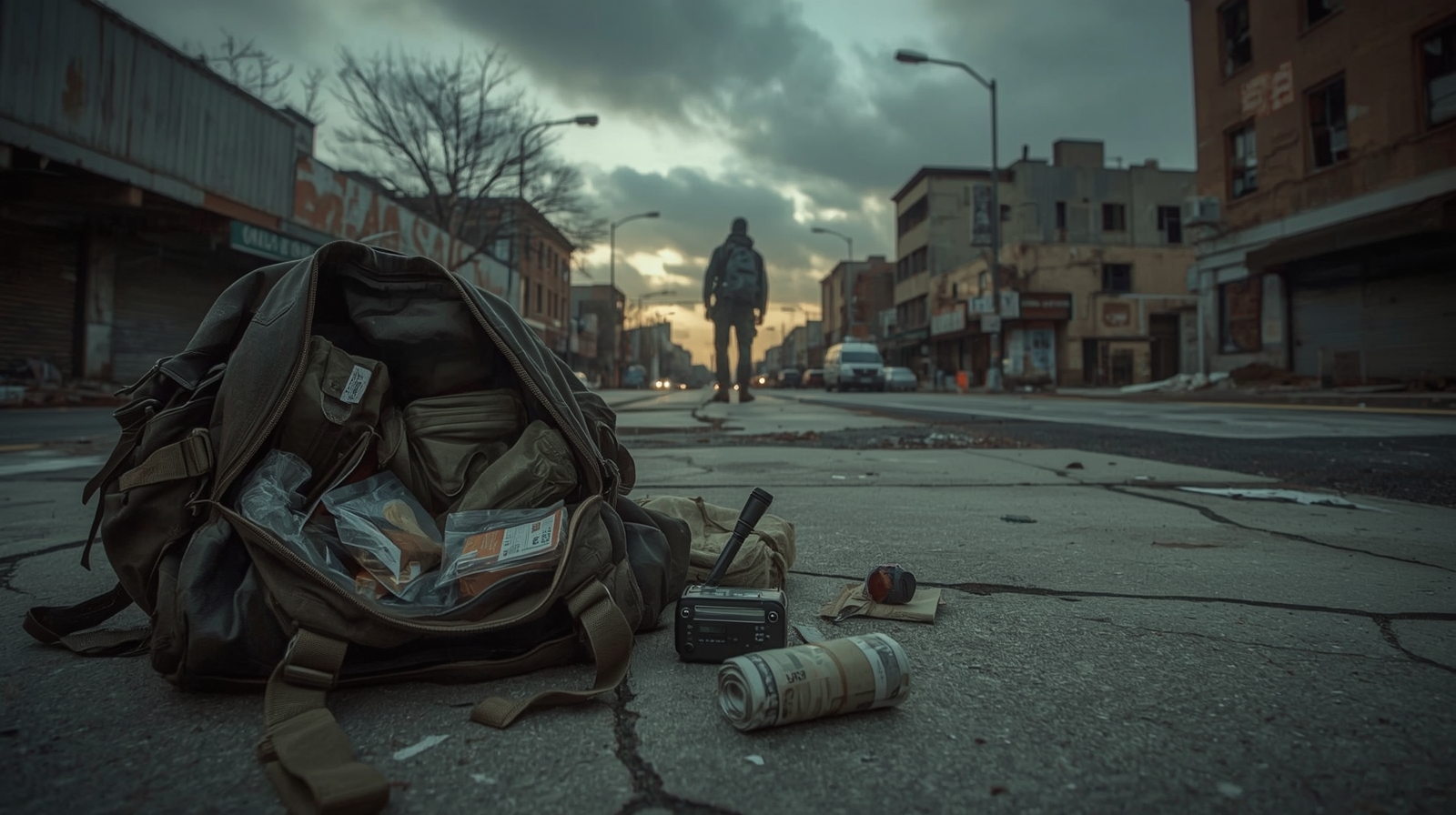
Why Urban Bug-Out Logic Is Fundamentally Different
Most survival frameworks were built around wilderness scenarios — extracting water from streams, building fire, navigating by terrain. Urban economic disruption operates on an entirely different set of priorities. When a city’s financial infrastructure fractures, the critical resources aren’t fire-starting tools and tarps. They’re identity documents, physical currency, communication devices, and the ability to move through a dense, stressed environment without drawing attention or slowing down.
This distinction changes every decision downstream. The gear that keeps you alive in a forest will weigh you down and mark you as a target on a city street. Economic disruption scenarios include currency devaluation events, banking system freezes, prolonged supply chain failures, civil unrest triggered by financial collapse, and extended grid-down situations in dense population centers. Each creates a different operational environment, but they share four common demands.
The four operational demands of urban economic disruption:
— Move: Navigate a stressed, potentially hostile urban environment on foot or by vehicle
— Identify: Prove who you are to access shelter, medical care, and assistance programs
— Spend: Function financially when card readers are offline and ATMs are empty
— Sustain: Maintain caloric and hydration capacity for 72 hours without resupply
A 72-hour urban bug-out bag is built around these four demands — not the backcountry checklist that dominates most prepper guides.
- Fire-starting tools and tinder kit
- Water extraction and long-duration filtration
- Topographic navigation, compass, topo maps
- Shelter construction materials, tent, tarp
- Signaling for rescue — mirror, whistle, PLB
- Large pack acceptable — no civilian observers
- Identity documents in waterproof carry
- Physical cash in small denominations, split across locations
- City maps, printed route plans, rally points
- Low-profile pack — reads as commuter or travel bag
- Communications that work without cell infrastructure
- Trauma kit tuned to crowd injuries, not sprains
Selecting the Right Pack: Capacity, Profile, and Construction
Your pack is the foundation of this entire build. Get it wrong and every item selection that follows is compromised. The core tension is between capacity and concealment — you need enough volume to carry a genuine 72-hour load, but a pack that signals “prepared for disaster” in a crowd is a liability before you’ve moved a single block.
Target the 30-to-40-liter range. This window gives you enough space for a complete kit without forcing you into the oversized mountaineering packs that signal tactical intent. Loaded weight should stay between 20 and 25 pounds. Beyond that threshold your movement speed drops, endurance degrades faster, and the physical strain compounds over multi-day scenarios in ways that affect decision-making as much as physical capability.
Construction specifications
| Spec | Requirement | Why It Matters |
|---|---|---|
| // Zippers | YKK brand, #8 or #10 | The most reliable under repeated stress and weather exposure. Off-brand zippers are the first failure point under sustained load. |
| // Stitching | Reinforced at stress points | Shoulder strap attachments, hip belt anchors, and handle seams are the failure points that appear first. Bar-tack or box-X stitching at minimum. |
| // Material | Water-resistant coated nylon | Baseline requirement. Full waterproofing is a bonus; if absent, use an internal pack liner. Cotton canvas fails immediately in sustained rain. |
| // Hip belt | Padded, load-bearing | Non-negotiable for any carry beyond two hours. Shifts majority of weight from shoulders to hips — the single most important fatigue-reduction feature. |
| // Frame | Internal frame sheet | Transfers load to hips efficiently. A frameless pack under 20+ lbs causes spinal compression and shoulder fatigue on multi-hour urban movement. |
| // Sternum strap | Present, adjustable | Prevents shoulder straps from spreading under load. Adds stability during rapid movement through crowds or obstacles. |
| // Color | ✓ Charcoal, dark navy, black | Reads as commuter or travel bag. Clean lines, no external hardware. |
| // Avoid | ✗ Coyote, ranger green, MOLLE webbing, military branding | Marks you as a prepper in a stressed environment. Invites attention from exactly the people you want to avoid. |
Load Architecture: Organizing for Speed and Security
How you organize your pack determines how quickly you can access critical items under pressure. In an urban disruption, you may need to produce cash, an ID, or a phone in seconds — on a crowded platform, at a checkpoint, or while moving. A three-tier access system solves this without exposing your full kit every time you reach inside. The logic is simple: access frequency determines zone assignment, not item importance.
- Phone — fully charged, screen-protector on
- Primary ID — government-issued photo ID
- Small cash reserve — $40–60 in fives and tens
- Any item you must produce without stopping or removing the pack
- Food — all items, accessible without unpacking
- Water filter and treatment tablets
- First aid kit — full, accessible with one hand
- Rain shell and any item accessed multiple times per day
- Power bank and charging cables
- Emergency bivy or compact sleeping bag
- Bulk water supply (if carrying 2L bottles)
- Document pouch — waterproofed, in dedicated internal pocket
- Full cash reserve — split from T1 carry
- Barter assets — cigarettes, OTC medications
The Documentation and Financial Layer
In an economic collapse scenario, your paperwork and physical assets may outperform every piece of gear in your bag. Electronic infrastructure is among the first casualties of serious economic disruption — cloud storage, digital wallets, and online records become inaccessible when networks fail. This layer is consistently under-prioritized by first-time builders and consistently the one that determines long-term outcomes.
Critical documents — physical copies in waterproof carry
-
□// IdentityGovernment-issued photo ID, passport, birth certificate copy, Social Security card copy. These unlock shelter intake, medical care, and access to assistance programs. Without them, you’re functionally invisible to institutions that need to verify who you are.
-
□// PropertyVehicle title, property deed or current lease agreement. Proof of ownership or residence may be required for re-entry, insurance claims, or establishing priority access to resources at distribution points.
-
□// InsuranceHealth, auto, and home policy summary pages with claim contact numbers printed clearly. Systems for filing claims may be operational before digital access is restored — having policy numbers on paper means you can start the process immediately.
-
□// FinancialRecent bank statement, account numbers, and routing numbers recorded in a small waterproof notebook. If digital banking is unavailable but physical branches are operating with limited capacity, account documentation accelerates access.
-
□// ContactsEmergency contacts, rally point addresses, and pre-planned evacuation routes — handwritten, not printed from a device. Every phone number your group needs must exist somewhere other than a phone that may be dead or confiscated.
-
□// DependentsFull matching documentation for every person traveling in your group. A parent who cannot prove they are the parent of a child in their care will encounter serious obstacles at checkpoints and intake facilities.
-
□// MedicalPrescription information, blood type, and known allergy list for each group member. Critical if any member receives care at a facility with no access to electronic health records — which is the default state in a serious disruption.
The document pocket holds documents and nothing else. Assign a dedicated internal pocket — ideally with a waterproof zipper pouch inside it — that contains only your document carry. If that pocket ever holds anything other than documents, it will eventually hold the wrong thing at the worst possible moment. This boundary is not a suggestion.
Physical assets: cash, silver, and barter
Water and Food: Sustaining 72 Hours While Moving
Caloric and hydration demands increase during crisis conditions. Stress hormones, physical exertion, disrupted sleep, and elevated alertness all drive up metabolic consumption. Plan for 1,800 to 2,200 calories per day across items that require no heat, no water, and no utensils to consume. You are not building a comfortable camp kitchen — you are fueling sustained movement and decision-making under stress.
Water — sourcing, treatment, and urban availability
Carry a minimum of two liters at departure — enough for the first several hours without requiring you to stop. Beyond that, your kit needs treatment capability rather than bulk water weight. A squeeze-style hollow fiber filter handles most urban water sources including tap water and standing water, removing bacteria and protozoa without chemicals or waiting time. Iodine or chlorine dioxide tablets serve as a chemical backup that weighs almost nothing and has no moving parts to fail.
Urban water sources during a disruption include building rooftop tanks, decorative fountains, fire hydrant connections (with appropriate fittings), and natural water features in city parks. Identifying these locations along your planned routes before you need them is more valuable than carrying extra bottle weight.
Food — calorie density, no-cook, minimal bulk
First Aid and Medical Preparedness: Urban Injury Profile
Urban disruption scenarios create specific injury profiles that differ from wilderness emergencies. Crowd injuries, civil unrest trauma, glass and debris lacerations, and stress-related medical events are more likely than the sprains and hypothermia that dominate backcountry first aid curricula. Your medical kit needs to reflect this reality — which means hemorrhage control comes first, everything else second.
Complete a Stop the Bleed course before finalizing your kit. A tourniquet and hemostatic gauze are only as useful as your ability to deploy them correctly under stress. A one-hour Stop the Bleed course teaches tourniquet application and wound packing in a way that no written guide can replicate. Find a course at stopthebleed.org — it’s free, takes an hour, and is available in most cities.
Communication, Navigation, and Power
In an economic disruption, information is a survival resource. Knowing which routes are passable, which areas have civil unrest, and where assistance is being distributed can determine your outcome as decisively as any physical gear. Your kit needs to support communication and navigation even when cellular infrastructure is degraded or overloaded — which it will be in the first 12 to 24 hours of any serious disruption.
- Battery-powered or hand-crank — receives emergency broadcast independently of cellular networks
- NOAA weather radio + AM/FM covers both official emergency broadcasts and local news stations
- Pre-program SAME (Specific Area Message Encoding) codes for your county for targeted alerts
- Minimum 72 hours of battery life on a fresh set — test before departure
- Extends phone operational life through the full 72-hour window from a fully charged bank
- 20,000mAh charges a modern smartphone 4–5 times — sufficient for the scenario even with heavy use
- USB-C input and output — covers most current devices plus legacy USB-A for older items
- Charge to 100% and test within 30 days of any deployment scenario — battery self-discharge is real
- Print your city’s street map and surrounding region before you need it — GPS and data may be unavailable
- Mark primary and alternate evacuation routes, rally points, and known resource locations in advance
- A laminated 5×7 route card for your most likely scenario fits in T1 alongside your ID
- Know the scale — estimate distances before you’re on foot without a working device
- Enable short-range communication with your group without relying on any infrastructure
- Function in environments where cellular networks are jammed, overloaded, or down entirely
- Pre-program your group’s primary and two backup channels before any scenario — not in the field
- Inexpensive, lightweight, and legal without a license on FRS channels (GMRS requires a license)
Shelter, Clothing, and Environmental Protection
Your shelter layer for a 72-hour urban scenario is lighter than a wilderness kit but cannot be omitted. A compact bivy or emergency sleeping bag handles overnight temperatures in most urban environments without the bulk of a full sleeping system. A lightweight rain shell serves double duty as wind protection and temperature regulation during movement — it is also the piece of clothing most likely to keep you functional through a cold, wet night if your situation extends beyond a comfortable timeline.
Prioritize clothing that allows full range of motion, dries quickly, and doesn’t identify you as someone carrying significant gear. No tactical pants, no brand-logo outdoor apparel that marks you as prepared. Dark, neutral, unremarkable.
Footwear is the single most consequential clothing decision in this build. Broken-in, supportive shoes or boots that you can move in for eight or more hours without developing blisters outperform any piece of technical gear in your pack. Test your footwear on long walks before you need it — two to three hours on hard pavement, fully loaded. Discovering a blister problem on day one of a real evacuation is a serious operational failure with no easy correction.
Final Assembly and Ongoing Readiness
A bug-out bag that sits in a closet for two years without maintenance is not a preparedness asset — it’s a false sense of security. Food expires. Batteries self-discharge. Documents become outdated. Medications pass their use-by dates. The bag that works is the one that has been maintained, loaded, and carried — not the one that looks complete on a checklist.
| Interval | Maintenance Task |
|---|---|
| // Monthly | Battery audit — check power bank charge level, test NOAA radio batteries, confirm FRS radio charge. A power bank left uncharged for 3 months loses 20–30% capacity before you even start. |
| // Quarterly | Food and water rotation — replace any food within 6 months of expiration date. Check water filter for damage or reduced flow. Restock any OTC medications used or expired. Audit barter assets — cigarettes and medications have shelf lives. |
| // Semi-Annual | Document review — verify all IDs are current, insurance policies are updated, financial account information is accurate, and contact lists reflect actual current numbers. Update printed route cards if your situation has changed. |
| // Semi-Annual | Loaded carry test — put on the fully loaded pack and walk for at least two hours on hard pavement in your actual footwear. Identify fit problems, weight distribution issues, hot spots under straps, and any gear that doesn’t perform as expected under real conditions. |
| // Annually | Full kit overhaul — replace all food and medications approaching expiration. Review and update the entire kit against your current life situation: family composition, location, vehicle, physical capability. The bag that fit your life two years ago may not fit your life now. |
| // After Any Event | Post-event debrief — after any emergency, disruption, or even a significant drill, identify what the bag got right, what was missing, and what wasn’t used. The most reliable way to improve the bag is to stress-test it against a real scenario and update based on what you learned. |
The bag that works is the one you’ve actually carried.
The 72-hour urban bug-out bag is not a one-time build. It’s a system that requires calibration against your actual environment, your physical capabilities, and the specific disruption scenarios most likely to affect your city. Start with the framework above, test it under realistic conditions, and adjust based on what you learn. The kit that looks complete on a checklist and the kit that actually performs after 20 miles on foot and two nights in urban shelter are often different bags — and the gap between them only closes through practice.
- Osprey Farpoint 40 / Fairview 40
- Mystery Ranch Urban Assault 24
- Tortuga Setout 35L
- NAR CAT Gen 7 — official manufacturer
- SOFTT-W as alternative wide-strap option
- Carry two: one accessible, one deep storage
- QuikClot Combat Gauze z-fold (3″)
- Celox Gauze as kaolin-free alternative
- Israeli Emergency Bandage for compression
- Sawyer Squeeze — 0.1 micron hollow fiber
- LifeStraw Peak Series as alternative
- Aquatabs or Potable Aqua as chemical backup
- Datrex 3600 — 9 × 400-cal blocks
- Mainstay 3600 as alternative
- Supplement with nut butter single-serve packets
- Midland ER310 — NOAA + AM/FM + USB out
- Kaito KA500 — solar + crank + multi-band
- Eoxsmile — 5000mAh bank integrated
- Anker 737 — 26,800mAh, fast charge
- Jackery Explorer 240 (extended outage)
- INIU BI-B61 — compact 20,000mAh
- Midland GXT1000VP4 — 50-channel GMRS
- Motorola T800 — Bluetooth app integration
- Baofeng UV-5R (amateur license required)