How to Build a Geopolitical Threat-Tiered EDC Kit: Everyday Carry Configurations for Economic Disruption and Civil Instability
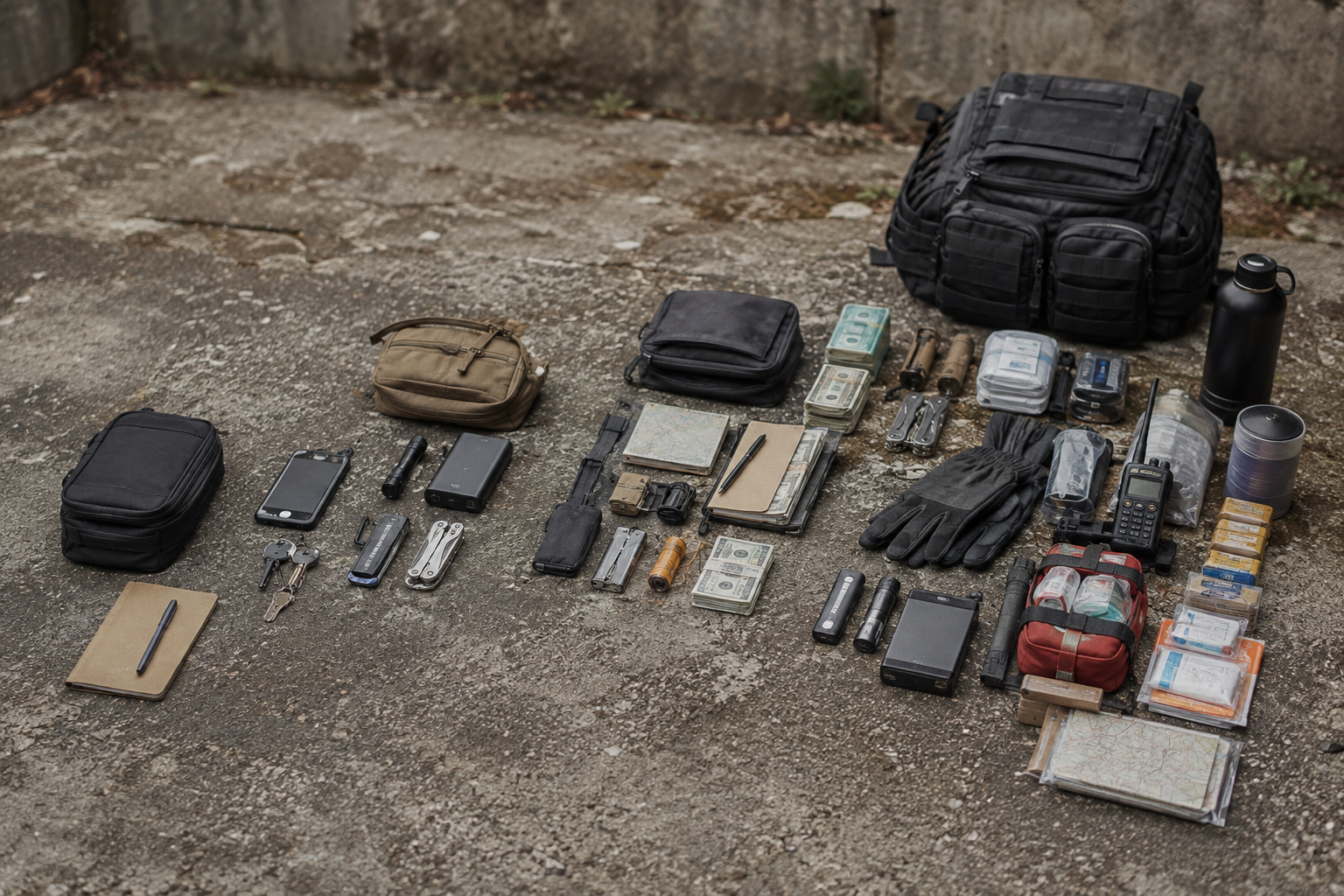
If you already carry an EDC kit and you’re reassessing it in response to economic uncertainty or geopolitical escalation, the answer isn’t to add everything at once. The most practical upgrade is a tiered threat-response model: three modular loadout configurations — Baseline, Elevated, and Acute — that you scale up or down based on daily situational assessment. Each tier builds on the last, so you’re never carrying redundant weight, and every item earns its place against a specific threat vector.
This framework is adapted from military mission planning principles, specifically the concept of graduated readiness states, and applied to civilian daily carry. It focuses on the person, not the cache — what you have on your body when infrastructure fails, civil order degrades, or economic disruption limits access to services you normally take for granted.
The Three-Tier Threat Model
Most civilians will spend the majority of their time at Tier 1, occasionally elevate to Tier 2 during periods of civil tension or travel through unstable areas, and only reach Tier 3 during acute crisis events. Knowing which tier you’re operating in on any given day determines what you carry — not anxiety, and not habit.
| Tier | Threat Environment | Carry Priority | Weight Target |
|---|---|---|---|
| Tier 1 — Baseline | Economic disruption, supply chain friction, infrastructure stress | Financial resilience, utility, communication | Under 1 lb added |
| Tier 2 — Elevated | Civil unrest, protest activity, localized disorder | Navigation, self-sufficiency, defensive awareness | 1–2 lbs added |
| Tier 3 — Acute | Active crisis, infrastructure failure, forced movement | Water, shelter initiation, medical, navigation | 2–4 lbs added |
Each tier is described as an additive layer. Tier 2 assumes you’re carrying everything in Tier 1. Tier 3 assumes both previous tiers are already on your person or in your immediate bag.
Tier 1 — Baseline Economic Disruption Loadout
Tier 1 addresses the most statistically likely threat civilians face during geopolitical instability: economic friction. ATM outages, card processing failures, supply shortages, and reduced emergency service response times are documented consequences of economic stress. Your baseline EDC should harden you against these without changing how you move through a normal day.
Financial Resilience Layer
Carry physical cash in small denominations — fives, tens, and twenties — in a dedicated RFID-blocking tactical wallet separate from your primary wallet. During economic disruption, card infrastructure fails before cash does, and small denominations matter when change is scarce. A slim, RFID-blocking wallet also protects against contactless card skimming.
A concealed cash carrier — a flat money belt or neck pouch worn under clothing — is worth adding for larger emergency reserves. This is about not having your entire financial capacity in one pocket during a period of elevated street crime risk, which correlates with economic downturns.
Utility and Communication Layer
A compact multitool is the single highest-utility item in any EDC kit. At Tier 1, prioritize one with pliers, a blade, a screwdriver set, and wire cutters. Leatherman and Gerber both produce sub-4-oz options that fit a jacket pocket or belt pouch without printing.
Add a portable battery bank (10,000 mAh minimum) with USB-C and USB-A outputs. Power grid reliability degrades during economic crises, and your phone is your primary communication, navigation, and emergency alert device. A bank at this capacity can fully recharge most smartphones two to three times.
A mechanical lighter and a small clip-on LED flashlight round out Tier 1, addressing the two most common minor infrastructure failures: power outages and gas interruptions.
Tier 1 Carry Summary
- RFID-blocking tactical wallet with small-denomination cash
- Concealed cash carrier or money belt
- Compact multitool (sub-4 oz, pliers-based)
- 10,000 mAh+ portable battery bank
- Mechanical lighter
- Clip-on LED flashlight
Tier 2 — Elevated Civil Instability Loadout
Tier 2 activates when civil order shows visible stress: organized protest activity near your daily routes, localized looting or property crime spikes, supply shortages causing public friction, or credible reporting of imminent civil disorder in your area. You’re still operating in your normal environment, but route planning, self-sufficiency, and defensive awareness all increase.
Navigation Independence
Do not rely exclusively on a phone for navigation at Tier 2. Cell networks saturate quickly during civil disturbances as call and data volume spikes. Carry a compact analog compass and paper maps — printed or waterproof map cards — of your city and immediate surrounding region. The goal is to navigate home or to a rally point if your phone dies or the network is unavailable.
A dedicated GPS device that operates on satellite signal independent of cell infrastructure is a meaningful Tier 2 upgrade, particularly if your daily commute takes you through areas that could become difficult to navigate during disorder.
Fixed-Blade Knife
At Tier 2, a dedicated fixed-blade knife with a 3–4 inch blade becomes relevant — not primarily as a defensive tool, but as a reliable, single-function cutting instrument that won’t fail under hard use the way a folding mechanism can. A drop point or clip point profile handles rope, cordage, packaging, and improvised shelter tasks better than a tanto, which is optimized for penetration. Always verify carry legality in your jurisdiction before adding a fixed blade to your EDC.
Personal Medical Layer
A compact individual first aid kit (IFAK) should be carried in a belt pouch or accessible bag pocket. Minimum contents: a tourniquet (CAT or SOFTT-W), hemostatic gauze, two pairs of nitrile gloves, a compression bandage, and a mylar emergency blanket. This addresses traumatic bleeding — the leading preventable cause of death in civilian mass casualty events — and basic environmental exposure.
Training matters more than kit contents. Stop the Bleed courses are widely available and free in many areas. A tourniquet carried by someone who has practiced applying it under stress is far more valuable than one carried by someone who hasn’t.
Tier 2 Carry Summary (additive to Tier 1)
- Compact analog compass
- Waterproof paper map of local area and alternate routes
- Compact GPS device (recommended)
- Fixed-blade knife, 3–4 inch, with kydex sheath (verify local legality)
- Compact IFAK: tourniquet, hemostatic gauze, gloves, compression bandage, mylar blanket
Tier 3 — Acute Crisis Loadout
Tier 3 is a genuine emergency configuration: infrastructure has failed, you may need to move on foot, and resupply is not available. This tier is not carried daily — it is pre-staged in a small sling bag, chest pack, or expanded belt kit that you grab when threat assessment shifts.
Water Procurement
A compact personal water filter — the Sawyer Squeeze and LifeStraw are widely recognized options — weighs 2–3 oz and fits in a jacket pocket. Combined with a collapsible water reservoir or heavy-duty zip-lock bag, it allows you to source water from urban fountains, streams, or standing water and render it safe to drink. Supplement with water purification tablets (chlorine dioxide preferred) as a redundant backup.
Shelter Initiation
A Tier 3 carry is not a full shelter kit — that lives in a bug-out bag. What you carry is shelter initiation capability: enough to get through one night or several hours of exposure while moving toward a stable position. A compact emergency bivy folds to the size of a deck of cards and provides meaningful thermal protection when used correctly. Pair it with the mylar blanket already in your IFAK. Add 25–50 feet of paracord and a compact emergency poncho or tarp; together these weigh under 8 oz and allow you to rig basic overhead shelter in most urban or semi-urban environments.
Extended Navigation and Communication
A personal locator beacon (PLB) or satellite communicator operates on satellite networks independent of terrestrial infrastructure. In an acute crisis involving widespread communication failure, the ability to send a distress signal or location update to a trusted contact is a significant force multiplier. If a PLB is outside your current budget, a hand-crank or solar emergency radio receiving NOAA weather alerts and AM/FM broadcasts provides situational awareness without relying on cell or internet infrastructure. Compact versions weigh under 6 oz.
Caloric Reserve
Carry 400–600 calories of compact, shelf-stable food: energy bars, compressed survival rations, or high-density trail food. This is not a meal plan — it is enough caloric input to maintain cognitive function and physical performance through a 12–24 hour period of elevated stress and movement.
Tier 3 Carry Summary (additive to Tiers 1 and 2, staged in a grab bag)
- Compact personal water filter (Sawyer Squeeze or equivalent)
- Water purification tablets (chlorine dioxide preferred)
- Collapsible water reservoir or heavy-duty storage bag
- Emergency bivy or compact sleeping bag liner
- 25–50 feet of paracord
- Emergency poncho or compact tarp
- Personal locator beacon or satellite communicator (or hand-crank emergency radio)
- 400–600 calories of compact shelf-stable food
Daily Threat Assessment: Deciding Which Tier to Carry
The tiered model only works with a consistent, low-friction daily process. A five-minute morning review of three inputs is sufficient:
- Local situational data: Check local news and emergency management feeds for reported civil disturbance, infrastructure disruption, or elevated crime activity in your daily operating area.
- Regional and national indicators: Track one or two reliable geopolitical and economic news sources. You’re looking for trajectory — is the situation stable, deteriorating, or escalating?
- Personal exposure assessment: Where are you going today? A familiar, low-density area warrants Tier 1. Travel through a city center during civil tension warrants Tier 2. Credible reason to believe infrastructure or civil order may fail warrants Tier 3 staging.
The goal is a deliberate, rational decision about your readiness state — not anxiety, and not complacency.
Weight and Budget Discipline
The most common failure mode in EDC upgrades during periods of anxiety is accumulation without architecture. Gear gets added reactively, weight exceeds the comfort threshold, and the loadout gets abandoned. The tiered model prevents this by forcing every item to justify its tier placement. Apply two filters to every potential addition:
- Threat specificity: Which specific threat vector does this item address, and at which tier does that threat become relevant? If you can’t answer clearly, the item doesn’t have a tier assignment and shouldn’t be in the loadout.
- Weight-to-utility ratio: Items addressing multiple threat vectors at low weight earn priority. A multitool covers utility, minor medical, and improvised repair simultaneously. A single-function item of equivalent weight is a lower-priority addition.
Build Tier 1 completely before purchasing Tier 2 items. Tier 3 staging, including a PLB or satellite communicator, represents the largest single investment but is also the least frequently deployed tier.
Legal and Contextual Carry Considerations
Knife carry laws vary significantly by jurisdiction — blade length limits, fixed versus folding restrictions, and concealed carry rules differ between states, counties, and municipalities in the United States, and vary more sharply internationally. Verify the specific regulations for every jurisdiction you regularly move through before adding a fixed blade, and recheck periodically as laws change.
The tiered EDC model described here does not address firearms carry, which involves a separate and jurisdiction-specific legal framework. If you carry a firearm as part of your existing EDC, that decision and its legal requirements remain independent of the tier system.
Workplace and venue restrictions are a practical constraint the tier model must accommodate. If your workplace prohibits bladed tools above a certain length, your Tier 2 fixed blade stays in your vehicle. Build your loadout around the most restrictive environment you regularly enter, and plan for what you can add when you exit it.
Integrating the Tiered EDC with Your Broader Preparedness System
The tiered EDC is the innermost ring of a broader preparedness architecture: what you have on your person. Your vehicle kit covers the next ring. Your home stockpile and bug-out bag cover the outer rings.
The practical integration point between your tiered EDC and your vehicle kit is your Tier 3 grab bag. Stage it in your vehicle when you’re not carrying it on your person, so escalating from Tier 2 to Tier 3 during your day requires only retrieving the bag from your car rather than returning home. This closes the gap between daily carry capability and full crisis readiness without requiring you to carry Tier 3 weight routinely.
Review your tier assignments and gear choices every 90 days, or immediately following any significant shift in your local or regional threat environment. EDC is an ongoing calibration between your assessed risk environment and your daily carry capability — not a one-time configuration.