Tarp Shelter Systems for Wind and Heavy Rain: Ridgelines, Storm Pitches, Guyline Angles, and Runoff Control
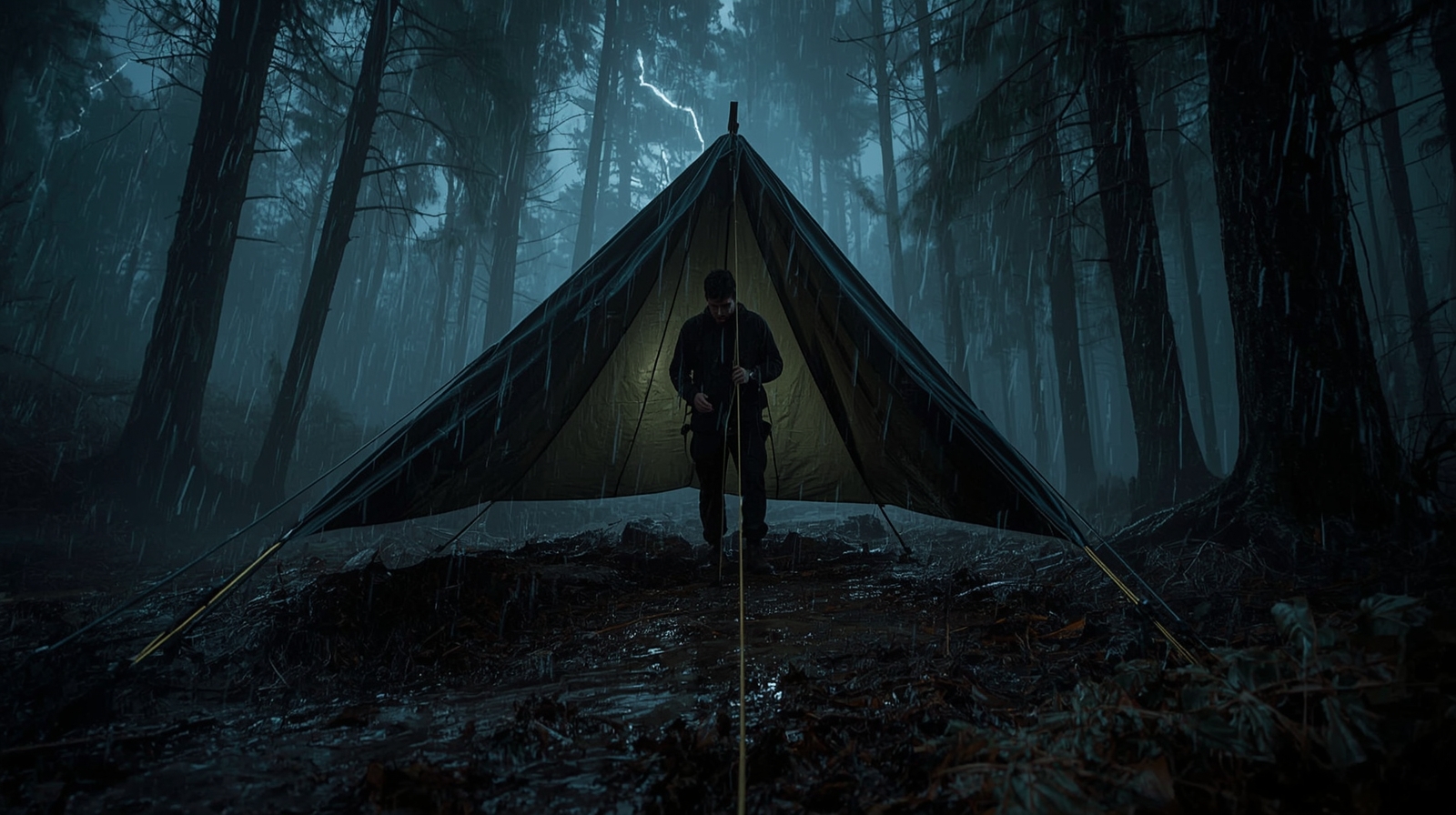
Wind-and-Rain Tarp Mindset: Think in Systems, Not Just Shapes
A tarp in calm weather is forgiving. In wind and heavy rain, it becomes an engineering problem you solve with simple parts: anchors, lines, fabric tension, and drainage. If one part fails, the whole shelter starts to unravel.
In military fieldcraft, we treat that as a system issue, not a bad-luck moment. The goal is a setup that keeps working when you’re tired, cold, and losing fine motor skills.
The good news is that a storm-worthy tarp doesn’t require exotic gear. It requires repeatable habits: orienting the tarp correctly, building ridgelines that don’t creep, managing guyline angles, and controlling runoff before it reaches your sleeping area. If you can do those things, you can ride out weather that has other camps packing up at 0200.
Common storm failure points (and what they look like)
Most tarp “failures” in wind and rain are predictable. The ridgeline sags, the windward edge lifts, or water starts sneaking under the tarp and pooling where you least want it.
In the field, you diagnose by symptoms. A few patterns show up again and again:
- Flapping fabric usually means poor tension or a bad orientation to the wind.
- Stakes pulling usually means wrong guyline angles, weak anchors, or the wrong stakes for the soil.
- Water intrusion usually means poor site selection or unmanaged runoff.
You want to catch these early. A little flutter becomes a torn tie-out after hours of cyclic loading. A small drip becomes a soaked sleeping bag once your ground insulation is compromised.
Load paths: where wind force actually goes
Wind doesn’t “hit the tarp evenly.” It creates pressure zones and transfers force to tie-outs, then to lines, then to stakes or trees.
Your job is to create clean load paths with minimal weak links. That means no sharp bends over bark that saw through cordage, no tiny stakes in soft soil on the windward side, and no single-point failures when a second anchor would cost you 60 seconds.
A practical way to think about it: the windward edge and corners carry most of the load. Reinforce them with better anchors and more conservative angles. The leeward side can be lighter, but it still needs enough tension to prevent the tarp from “pumping.”
Weather reading for tarp users
Before you pitch, take a minute to read the terrain like a weather map. Wind funnels through saddles, along lakes, and up valleys.
Heavy rain turns flat spots into puddles and shallow channels into rivers. If you’re not sure how your area drains, look for matted grass, silt lines, and debris that indicates recent water flow.
If conditions look unstable, build margin into your plan. Pitch lower, tighten more, and choose a configuration that can be adjusted quickly. Your objective isn’t comfort first-it’s staying dry and keeping gear functional.
Ridgelines That Hold: Knots, Hardware, and Tension Management
Once you’ve got the “systems” mindset, the ridgeline is the next priority. A storm tarp lives or dies here.
If the ridgeline sags, your pitch loses shape, your runoff path changes, and wind starts snapping the fabric like a sail. The ridgeline should be tight, abrasion-resistant, and easy to re-tension without rebuilding the entire shelter.
I prefer systems that let you adjust under load. In heavy rain, you don’t want to untie soaked knots with numb hands. You want to pull, lock, and be done.
Continuous ridgeline vs split ridgeline
A continuous ridgeline is one line running between trees with the tarp attached via prusiks or soft shackles. It’s stable and adjustable.
It spreads load across the line, and you can slide the tarp to center it without retying. It also gives you a built-in place to hang wet gear under cover.
A split ridgeline uses two lines from tarp ends to anchors. It can be lighter and simpler, but the downside is alignment: if one end creeps, your whole shelter twists. In storm conditions, a continuous ridgeline is usually more forgiving because you can re-tension and reposition quickly.
Knots and tensioners that behave in the wet
For manual tension, the trucker’s hitch is still a workhorse. It gives mechanical advantage and can be secured with a slippery half hitch for faster release.
For adjustability at the tarp, prusiks on a continuous ridgeline are excellent because they bite under load but can be slid when unloaded.
Hardware tensioners (line-locs, titanium hooks, or small cam devices) can speed things up. Still, you should test them in rain with cold hands. Some slip on slick cord, and some are hard to clear when frozen or muddy.
If you use hardware, back it up with a knot you trust. That’s cheap insurance.
Abrasion control and stretch management
Wind makes your ridgeline move. If your line runs directly over rough bark, it can fuzz and weaken fast.
Wrap the tree with a strap, a bandana, or a sacrificial sleeve if you’re staying multiple nights. Also pay attention to cord stretch:
- Nylon stretches more when wet.
- Polyester stretches less.
- UHMWPE (Dyneema-style) stretches very little, but can be slick on some hardware.
Expect to re-tension after the tarp gets wet. A good storm setup includes a quick “tighten cycle” about 15-30 minutes after pitching, once the fabric and line settle.
Storm Pitch Geometry: Shapes That Shed Wind and Water
With a solid ridgeline, you can finally focus on geometry. In storms, you’re not pitching for views or headroom.
You’re pitching for wind shedding, runoff control, and structural stability. That usually means lower profiles, steeper panels, and fewer big flat surfaces that catch gusts.
Different pitches excel in different conditions. A-frames are versatile, half-pyramids handle wind well, and low asymmetric pitches can be excellent when you know the wind direction won’t swing.
If you’re unsure, choose a pitch that can tolerate a wind shift without collapsing. When the weather gets chaotic, adaptability beats elegance.
Low A-frame: the dependable baseline
A low A-frame is the tarp equivalent of a fighting position: simple, fast, and reliable.
Run the ridgeline low enough that the windward side is close to the ground, then angle the leeward side slightly higher for ventilation. The steeper you make the panels, the better they shed rain instead of pooling.
When rain is hammering, resist the urge to raise the ridgeline for comfort. Headroom is nice until wind-driven rain starts entering through gaps.
A low A-frame also makes it easier to add extra stakes along the sides for better panel control.
Half-pyramid (half-mid): stronger in shifting wind
The half-pyramid uses one high point (a trekking pole or tree attachment) and a broad, low windward side. It’s excellent when wind is strong because it presents a smaller “sail” and braces the structure with multiple guy points.
It also tends to shed runoff away from the sleeping area if you orient the open side leeward. That’s a small detail that pays off all night.
This pitch is useful when you can’t find two perfect trees for a ridgeline. It’s also a good option above treeline where anchors are marginal and you need fewer high-tension points.
Flying diamond and plow-point: fast emergency storm covers
The flying diamond is quick and works well for short-duration storms or lunch stops, but it’s more sensitive to wind shifts.
The plow-point (a more enclosed version with a low nose into the wind) is a better true-storm option. In both cases, the “nose” stake and guyline must be strong, because it takes the brunt of wind pressure.
If you’re building a storm pitch late, prioritize getting the windward edge pinned first. Once the windward side is secure, the rest of the setup becomes calmer and easier to finish.
Storm pitch comparison table
| Pitch style | Wind performance | Rain shedding | Setup speed | Best use case |
|---|---|---|---|---|
| Low A-frame | High (if low) | High | Fast | All-around storms with known wind direction |
| Half-pyramid | Very high | High | Moderate | Strong wind, fewer anchor points, uncertain terrain |
| Plow-point | High | Moderate-High | Fast | Sudden squalls, directional wind |
| Flying diamond | Moderate | Moderate | Very fast | Short stops, mild storms, quick cover |
Guyline Angles and Stake Placement: Real Holding Power in Bad Soil
Once you’ve chosen a storm pitch, guylines make it real. This is where theory meets ground truth.
In storms, you’ll learn quickly whether your angle and anchor choice actually hold. Most tarp problems that look like “fabric failure” are really stake failures-either the stake is wrong for the soil, or the pull direction is wrong.
A storm-ready tarp uses guylines to do two things:
- Maintain shape (tension)
- Resist uplift (wind)
Those aren’t always the same direction of pull, which is why adding a second stake or changing angle can fix issues instantly.
Guyline angles: the 45-degree rule and when to break it
A good default is to run guylines out at roughly 45 degrees from the tarp edge and down at a low angle to the ground. That spreads the load and reduces the tendency for a stake to lever out.
If your line is too vertical, it yanks stakes out. If it’s too horizontal, it may not keep the tarp tight.
In very high wind, you often want wider angles and longer guylines to reduce peak forces. In tight terrain, you may have to go steeper. If you do, compensate with better anchors: thicker stakes, rocks, or deadman anchors.
Stake selection by soil type (and improvising anchors)
Soil dictates stakes. Hard-packed ground likes robust stakes you can drive without bending. Loose sand or duff needs longer, wider stakes or buried anchors.
If you’re on alpine tundra, rock anchors often beat any stake you brought. Don’t fight the ground; use what it gives you.
Improvised anchors are a core skill. Options that work when the soil doesn’t:
- Place a heavy rock on top of a stake to increase resistance.
- Wrap the guyline around a rock with a friction hitch.
- In snow or loose sand, bury a stick, stake bag, or stuff sack filled with snow/sand as a deadman.
Whatever you do, align the anchor with the pull direction. Misalignment is a silent failure.
Redundancy where it matters most
In operational planning, redundancy goes where failure is catastrophic. For tarps, that’s the windward corners and any pole apex point.
Doubling those anchors can be the difference between a noisy but stable night and a full reset in the rain.
Two simple ways to add margin:
- A “Y-strap” split, where one corner line splits into two stakes that share the load.
- A backup rock positioned so if the stake starts to pull, the rock prevents full extraction.
Runoff Control: Drip Lines, Edges, and Keeping Water Out of Your Sleep Area
With wind handled, rain becomes your next enemy. Heavy rain isn’t just water from above.
It’s also splash, sheet flow, and water running down lines and supports. If you don’t manage runoff, you’ll end up with water tracking straight into your shelter, soaking your ground insulation first-the failure that’s hardest to recover from.
Runoff control starts before you pitch: pick high ground, avoid depressions, and look at how water will move if the rain doubles. Once you pitch, you add small controls that prevent predictable leaks.
Drip lines on ridgelines and tie-outs
Water loves to follow cordage. If you have a ridgeline running to a tree, water can travel right along it and drip exactly where you don’t want it.
A drip line is a simple fix: tie a short piece of cord, a strip of cloth, or even a shoelace onto the ridgeline under the tarp and a few inches before the tarp connection point. Water hits that “interrupt” and drips off before it reaches your shelter.
Place drip lines on:
- Ridgelines near tarp attachment points
- Guyline runs that angle inward under the tarp edge
- Any line that routes toward your sleeping area
It’s a small step, but in sustained rain it’s one of the highest return moves you can make.
Edge management: splash control and ground clearance
Even with perfect drip lines, splash will still happen. If the tarp edge is high, raindrops hit the ground and rebound under your shelter.
To reduce splash:
- Lower the windward edge close to the ground.
- Keep the tarp panels steep so water runs off fast.
- Use additional side tie-outs to prevent fabric from bowing inward.
At the same time, avoid sealing the tarp to the ground on all sides unless you must. A fully sealed pitch can trap humidity and drive condensation. In storms, you’re balancing water protection with just enough airflow to keep your sleep system from getting clammy.
Runoff avoidance: site choice beats digging
If you set up in a natural drainage line, you’re going to lose eventually. You may not notice it at first, but once the ground saturates, sheet flow starts finding the lowest path.
A few quick site checks before you commit:
- Look for subtle channels, flattened grass, or debris lines.
- Avoid the base of smooth rock slabs where water sheets off.
- Don’t camp in low bowls that have nowhere for water to go.
If you’re tempted to dig trenches, pause. In most recreational settings, digging is discouraged because it damages the site. The better practice is to move your shelter a few yards to higher, better-draining ground and pitch lower.