Trekking Pole Techniques for Steep and Unstable Ground: Planting Angles, Bracing Moves, and Self-Belay Methods to Prevent Falls
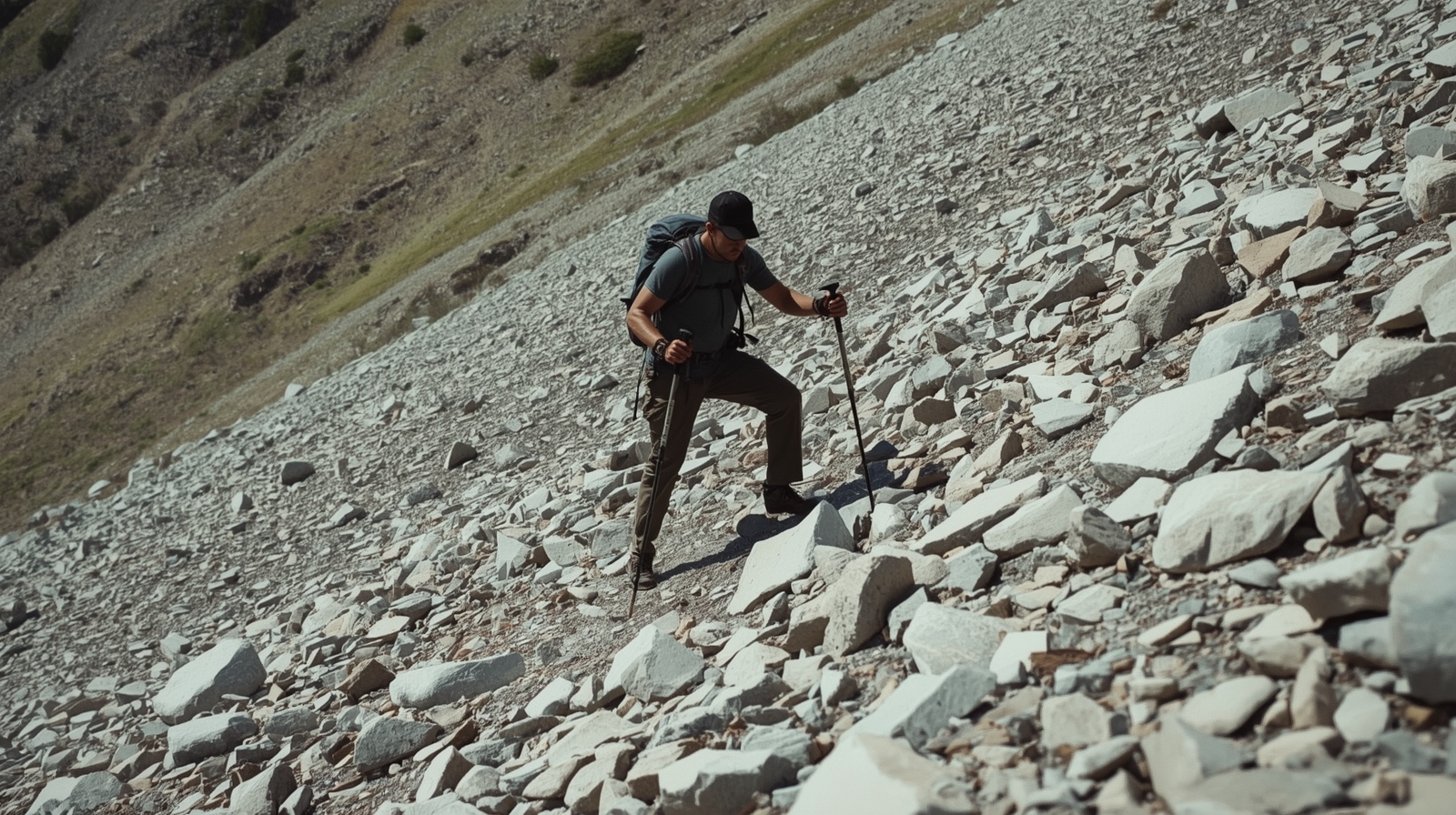
Why trekking poles prevent falls on steep and unstable ground
Steep terrain exposes one simple truth: your balance margin gets thin. On flat trail, a small stumble is a shrug. On scree, wet roots, or hardpan above exposure, that same stumble can turn into a slide or a bounce.
Related Articles:
Trekking poles work because they add two more contact points and let you manage load transfer. When foot placement is uncertain, you can weight the poles briefly to “bridge” the moment between steps.
The goal isn’t to lean on poles like crutches all day. The goal is to create controlled, repeatable moments of stability when the ground is trying to move.
Think in terms of a stability budget
On unstable ground, you’re constantly spending and replenishing balance. Every long step, every pivot, and every reach for a handhold costs stability.
Poles help you keep a reserve. A useful way to frame it is: feet move the body, poles protect the body. Your feet still do the primary work, but poles act like a safety line that catches micro-errors before they become full-body errors.
If you hike with a heavy pack, your stability budget is smaller. Your center of mass is higher and often more rearward, especially on descents. Poles let you shift some load into your arms and shoulders for short bursts, which can keep a boot from skittering downhill.
What poles can and can’t do in real terrain
Poles are not ice axes, and they’re not climbing protection. They are excellent for preventing the kind of fall that starts with a foot slip.
They can also reduce ankle rolls. If your foot lands on a moving rock, a properly planted pole gives you a third point of force to keep the ankle from collapsing inward.
What they can’t do is reliably stop a fast, committed slide on snow or scree once you’re fully moving. That’s why this article emphasizes prevention: planting angles, timing, and bracing moves that keep you from crossing the point of no return.
Terrain risk management still matters
Good pole technique doesn’t replace good route choices. If the slope is steep enough that a fall would be catastrophic, treat it like a decision point, not “just another section.”
For loose rock movement rules and spacing, pair this with Traveling Safely on Loose Terrain: Scree, Talus, and Rockfall Movement Techniques. You’ll move better when you understand how the slope fails.
For general hiking safety guidance from an authoritative source, the National Park Service has a clear overview of risk factors and prevention habits in its hiking safety resources.
Quick reference: Poles reduce falls by (1) increasing contact points, (2) allowing micro-weight transfer, and (3) improving timing and rhythm when footing is uncertain.
Dialing in pole length, straps, and tip setup before the slope
Most pole problems on steep ground aren’t strength issues. They’re setup issues.
If your poles are the wrong length or your straps are fighting you, you’ll plant late and plant shallow. That costs you stability right when you need it most.
The best time to fix setup is before the slope steepens. Once you’re on the pitch, you’ll rush, and rushed adjustments lead to dropped poles and missed plants.
Pole length adjustments for climbing, descending, and sidehill
Start with a simple baseline: on level ground, your elbow should be around 90 degrees when the tip is on the ground near your foot.
From that baseline, adjust to match the slope:
- Steep uphill: shorten poles slightly so plants stay close to your body.
- Steep downhill: lengthen poles so you can plant below your feet and “brake” before committing.
- Sidehill: run one pole longer (downhill side) and one shorter (uphill side) to level your shoulders.
Shorter uphill poles keep you from overreaching. Overreaching tends to pull you forward and compromise foot placement. Longer downhill poles let you probe and set a third point of contact before your boot loads the step.
Strap use: secure support without getting trapped
Straps are a force multiplier when used correctly. Put your hand up through the strap from below, then grip the handle so the strap crosses the back of your hand and supports your palm.
That setup lets you press down without death-gripping. It also keeps your hands fresher over long descents.
On steep, high-consequence terrain, consider loosening straps or even going strapless if there’s a real risk of the pole getting caught during a fall. A trapped hand can turn a slip into a wrist or shoulder injury.
A practical compromise looks like this:
- Use straps in moderate steepness for efficiency.
- Go strapless when edging around rock, moving through thick roots, or stepping across gaps where a pole could snag.
Tips, baskets, and rubber caps: matching the surface
Carbide tips bite well in dirt and rock seams. Rubber caps reduce noise and protect rock, but they also reduce bite on wet rock and mud.
If the slope is slick, prioritize traction over convenience. A “quiet” pole that skates is just extra clutter in your hands.
Baskets matter in soft ground and snow:
- A small trekking basket can prevent deep punch-through in duff and mud.
- A larger powder basket keeps the pole from spearing too deep in snow, which prevents sudden support collapse.
If you’re building out a more complete movement-and-safety kit, browse the site’s Backcountry Safety category and think in systems: traction, first aid, comms, and movement tools all reinforce each other.
With setup dialed, you’re ready for the part that actually keeps you upright: planting angles.
Planting angles that hold: uphill, downhill, and sidehill
Planting “somewhere in front of you” is not a technique. On steep and unstable ground, the angle of the shaft and where the tip lands relative to your foot determines whether the pole supports you or skates.
A strong plant is quiet and deliberate. It’s also repeatable.
You should be able to describe your plant in plain language:
- Where the tip goes
- How much weight you apply
- When you unload and move it
Uphill planting: close, vertical, and slightly downhill
On steep uphill, plant close to your uphill foot, not far out in front. Aim for a shaft angle that’s close to vertical, with the tip slightly downhill from your hand.
If the pole is too far forward, you end up pulling yourself toward the pole instead of pushing the ground away. That makes your feet chase your hands, and your steps get long and sloppy.
A solid uphill rhythm is:
- Plant both poles (or one, if you’re using a single)
- Step up
- Drive down through the straps to stabilize as the rear foot comes forward
Keep your hips over your feet. If your hips drift behind, you’ll feel it quickly in your calves and lower back.
Downhill planting: “probe, set, step” with a braking angle
Downhill is where falls happen fast, so slow the sequence down. Use a three-part rhythm: probe the landing, set the pole, then step.
Plant the tip slightly downhill and out from your foot, with the shaft angled back toward you. That backward angle creates a braking component.
If your foot slips, the pole can take a brief load without collapsing. You’re not trying to “hang” on it. You’re buying a fraction of a second to reset your feet.
Avoid planting straight downhill with the shaft angled forward away from you. That position tends to fold if you load it suddenly, and it encourages you to lean downhill, which is exactly what you’re trying not to do.
Sidehill planting: triangulate against the slope
Sidehill travel is where ankles and knees get punished. Your objective is to keep your torso upright while your feet are tilted.
Use the downhill pole as your primary support. Plant it slightly below and ahead of your downhill foot so it forms a triangle with your legs.
The uphill pole becomes a stabilizer and probe. If the slope is loose, don’t rely on one “hero plant.” Make two lighter plants instead of one heavy one, because heavy plants on loose gravel can cause the tip to plow and suddenly release.
At-a-glance planting cues: Uphill = close and vertical. Downhill = below you with the shaft angled back. Sidehill = downhill pole builds the triangle.
Next comes the part that saves you during transitions: bracing moves.
Bracing moves for momentary stability: tripod, A-frame, and hip checks
When the ground is unreliable, you need moves that create stability fast without overthinking. In the military, we trained for repeatable actions under stress.
The terrain doesn’t care that you’re tired, cold, or distracted. Gravity is patient.
Bracing moves are short, intentional positions you use during transitions:
- stepping over a log
- crossing a narrow gully
- negotiating a loose step
- pausing to breathe without sliding
The tripod stance for step transitions
Tripod means two poles planted plus one foot planted while the other foot moves. You’re creating three points of contact at all times.
Here’s a clean sequence for steep downhill:
- Probe and plant both poles below you, shoulder-width apart.
- Shift some weight into the poles, keeping elbows slightly bent.
- Move one foot down to the next stable spot.
- Re-center your hips over that foot.
- Bring the second foot down only after you’re stable.
The common mistake is moving both feet while the poles are mid-swing. That’s when a single slip becomes a full-body slide.
The A-frame brace for loose ledges and narrow steps
The A-frame is when you plant both poles wide and forward so the shafts form an “A” shape. This gives you lateral resistance when you’re worried about a sideways skid.
Plant the tips into something that won’t move:
- a crack
- a firm dirt shelf
- behind a rock nub
If you’re on scree over hardpan, dig the tips in gently and test load before committing.
Use the A-frame when stepping down off a small ledge. You can lower your body under control, using your arms to modulate speed, rather than dropping onto a questionable landing.
The hip check: using poles to keep your center of mass uphill
A common steep-ground failure is your hips drifting downhill. Once your center of mass is below your feet, your boots scramble to catch up.
Use a simple cue: keep your uphill hip slightly higher, and keep your chest facing more uphill than you think you need. The downhill pole gives you permission to hold that posture.
If you feel your torso leaning downhill, stop and reset with a tripod stance. It’s faster to reset than to recover from a slip.
Once you can brace, you can start moving with a more deliberate self-belay mindset.
Self-belay with poles: micro-arrests, controlled descents, and handline substitutes
Self-belay is a fancy way of saying you’re staying attached to stability while you move. With trekking poles, you’re not placing gear into rock.
Instead, you’re creating a continuous sequence of support so that if one contact point fails, the others keep you upright.
This matters any time the consequence of a fall is high, even if the terrain isn’t technical climbing.
Micro-arrests: catching the first inch of a slip
Most slips start small: a boot skates an inch, gravel shifts, a root rolls under your tread. Your job is to catch the slip early.
When you feel movement, drive the pole tips down and slightly behind you while dropping your hips. Think: sit back into the poles.
That keeps your center of mass uphill and increases friction at your boots. Do not try to save a slip by lunging forward downhill. That converts a small slip into acceleration.
Controlled descents: building a brake with each step
On very steep dirt or ball-bearing gravel, use poles like a ratchet. Plant both poles below you, load them lightly, then step down one foot at a time.
Keep your steps short. Short steps reduce the shear force that wants to send your boot sliding.
If the slope is so steep that you’re essentially downclimbing, turn slightly sideways and use the downhill pole as the primary brake. Keep your uphill hand free for the slope if there are roots or rock to touch.
Handline substitute: two-point contact through transitions
Sometimes you’ll hit a short section where you wish you had a fixed handline. You can simulate some of that security by planting one pole, transferring weight, then moving the second pole only after the first is set.
This is simple, but under stress people “double-move” both poles at once. Treat your poles like anchors: one is always set while the other moves.
If you do fall and need to manage injuries or immobilize a limb, trekking poles can become medical tools. We’ve covered the rigging principles in Improvised Splints That Actually Hold: Trekking Pole Splints, Pack Frames, Rigging Principles.
Now let’s apply those ideas to specific problem surfaces.
Footwork and pole timing on loose surfaces (scree, mud, wet roots)
Poles don’t replace footwork. They complement it.
On loose ground, the most reliable strategy is minimizing sudden force spikes. That means no stomping, no bounding, and no long reaches that load a single point.
Timing matters more than strength. Planting late is the same as not planting at all.
Scree and pea gravel: light steps and tested plants
Scree movement is about managing small slides. Your feet will move a little; that’s normal.
The goal is to keep those micro-slides from becoming a run. Use poles to test the layer.
- If your tip punches through to hardpan, you may have a stable plant.
- If it keeps sinking, treat it as unreliable and reduce how much weight you put on it.
Keep your steps short and flat-footed. On steep scree, a slight heel-first strike can act like a brake, but only if the layer is shallow. Deep scree will just roll under your heel.
For more detailed movement rules and group spacing in rockfall terrain, refer back to our scree and talus travel techniques.
Mud and steep dirt: don’t “stab,” place and load gradually
In mud, pole tips often skate because the surface shears. Instead of stabbing, place the tip with a slight forward push to seat it, then load gradually.
Look for edges and structure:
- grass clumps
- exposed roots
- embedded stones
- the uphill side of a step
Plant into structure, not into slime.
On steep dirt, consider using the pole tip like a tent stake: drive it in on a slight backward angle so it resists sliding. If the dirt is too soft to hold, widen your stance and use two lighter plants rather than one heavy one.
Wet roots and rock: friction is low, so prioritize balance over speed
Wet roots and rock behave like greased rails. Assume friction is low and adjust your pace before you step onto them.
Use poles to probe for texture (bark ridges, rock seams, grit patches) instead of committing your boot first. When you do step, keep the step short and keep your hips stacked over your feet.
Two practical rules help here:
- Keep at least one pole planted during every step transition.
- If you can’t find a trustworthy plant, slow down and switch to a tripod rhythm until you’re past the slick section.