Ham Radio vs. GMRS vs. FRS: How to Choose Your First Emergency Communication Setup
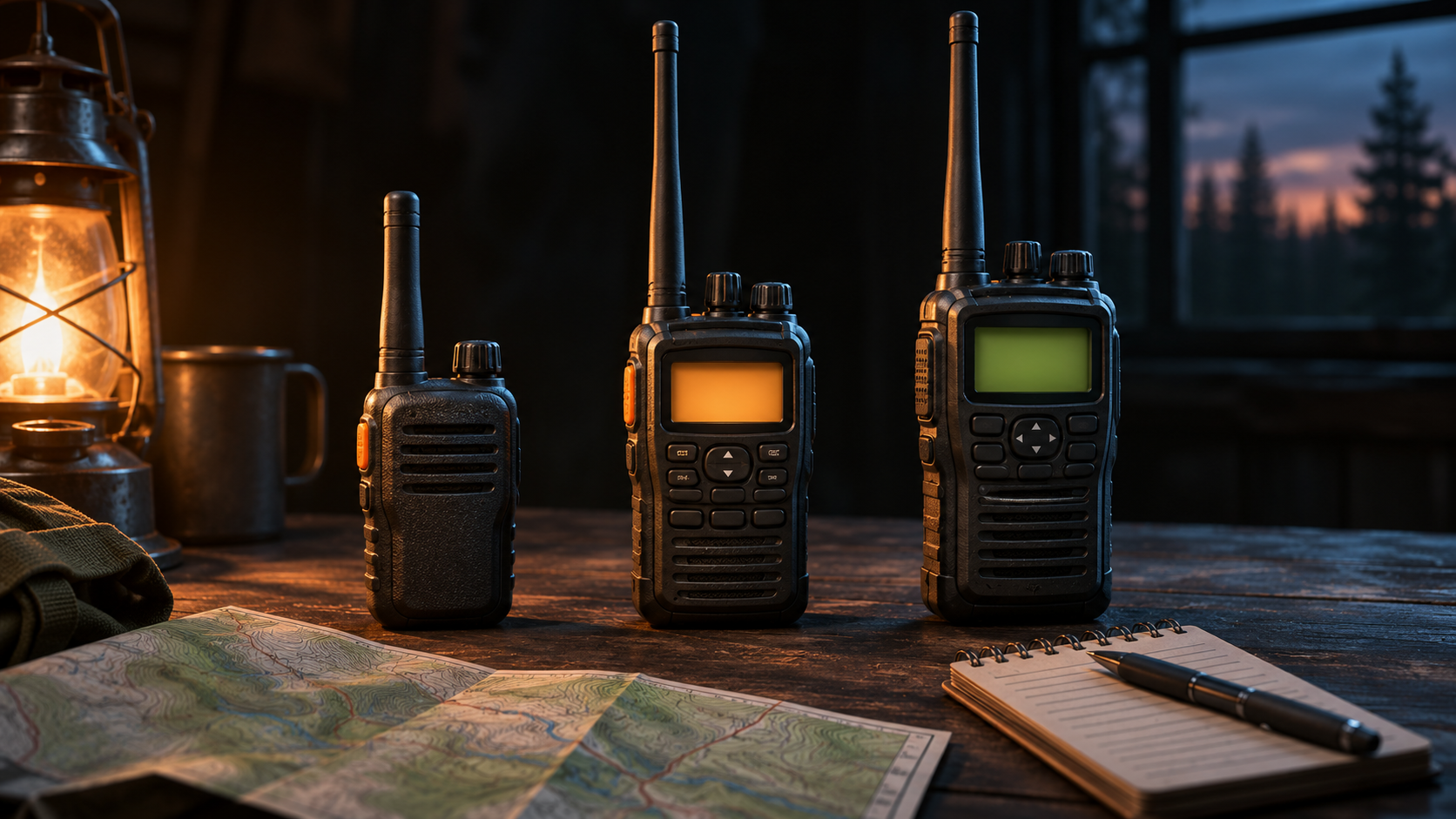
You have a radio in your cart, a family member across town, and one question: will this actually let us talk when our phones stop working?
The answer starts with the people and places you need to connect. For nearby family communication, certified FRS walkie-talkies are the simplest starting point. GMRS adds options for a more capable local setup, with an FCC license. Ham radio suits people who want to learn radio as a skill and build beyond basic household communication.
This guide focuses on U.S. use. It explains the differences, the limits behind “long range” claims, and what to buy after you have worked out the job your radios need to do.
As an Amazon Associate, Military Trained earns from qualifying purchases. The product links below are affiliate links. Recommendations are based on documented features and intended use, not hands-on testing.
Start With the Person at the Other End
A radio is only useful if someone can hear you and knows when to listen. Before comparing brands, write down who you need to reach, where each person will be, and whether everyone is willing to learn the equipment.
- No individual FCC license with compliant equipment.
- Start here for a campsite or nearby property.
- Test coverage at the places you need.
- FCC license required.
- Qualifying immediate family can share the license.
- Check local repeater access before buying.
- Amateur license and operating knowledge required.
- A VHF/UHF handheld is a local starting point.
- Choose this if you want to learn and practice.
- Do not rely on an ordinary handheld pair.
- Plan contact methods and missed check-ins.
- Get local advice and test both endpoints.
“Walkie-talkie” describes a handheld two-way radio. It does not tell you which radio service it uses, whether a license is required, or how far it will work.
FRS: The Straightforward Family Starting Point
Family Radio Service radios are a practical option when your priority is handing someone a radio they can learn quickly. In the U.S., compliant FRS equipment can be used without an individual FCC license. Buy a model explicitly identified as FRS, with the appropriate certification, rather than a programmable ham radio that happens to accept the same frequency.
Choose clear controls, an easy-to-find push-to-talk button, and a power arrangement your household can maintain. A complicated menu is little help if the person carrying the second radio cannot change the volume or recognize a low battery.
FRS is a sensible first comparison for a campsite, nearby neighbors, or a small property. Buildings, slopes, vegetation, and the positions of the users can reduce coverage. Try the places you actually need to reach before relying on the radios.
GMRS: More Options for a Local Family Network
General Mobile Radio Service requires an FCC license. An individual license can cover the license holder and qualifying immediate family members, as defined in the rules. It does not automatically cover every friend or neighbor in your group. See 47 CFR § 95.1705 for eligibility and family operation.
GMRS can suit a household that wants handhelds now and the option of suitable vehicle equipment or repeater access later. A repeater receives a signal and retransmits it from another location, often with a better antenna position. It can improve coverage, but only where your radios can reach it and you are authorized to use it.
Before spending more for repeater capability, find out whether a useful local repeater exists, whether its owner permits your use, and whether it covers both ends of your intended route. Ask about backup power. Keep a direct radio-to-radio fallback because a repeater can go offline.
Use equipment certified for GMRS. Programming GMRS frequencies into an amateur handheld does not by itself make that radio a compliant GMRS transmitter. The requirement is set out in 47 CFR § 95.1761.
Ham Radio: Choose It When You Want to Learn the System
Amateur radio offers room to develop skills, experiment with antennas, and participate in local radio communities. It also requires learning the operating rules. For most U.S. beginners, the Technician license is the entry point and involves a 35-question exam. The ARRL licensing guide explains the available license classes and how to begin.
A dual-band VHF/UHF handheld can be a useful learning tool for local amateur communication. It does not become a nationwide radio because the listing says “ham,” “high power,” or “long range.” Longer-distance amateur communication may call for different bands, antennas, equipment, and license privileges.
Budget handhelds can make sense for someone willing to learn programming and troubleshoot settings. For a first purchase, prioritize a readable manual, supported programming methods, replacement batteries, and help from an experienced local operator. Confirm the exact model: similar names and nearly identical cases can hide different capabilities.
If the rest of your family only wants a simple way to check in, choose their equipment around that need. One person’s interest in amateur radio does not mean everyone else wants the same learning curve.
What “Long Range” Leaves Out
The large mileage number on a package is not a promise for your neighborhood. Radio position and obstructions matter. A clear path from elevated ground can behave very differently from a street lined with buildings or a route behind a ridge. Midland’s range guidance explains why line of sight and obstacles affect two-way communication.
More transmitter power does not remove a hill. An antenna upgrade does not guarantee that someone inside a distant building can hear you. Evaluate a complete link, with usable audio in both directions, rather than the strongest specification on one radio.
For family 100 miles away, keep working phone and text options in your plan, establish an out-of-area contact, and agree on what to do if messages fail. If you need an additional long-distance system, investigate it separately with local expertise and test both endpoints. Do not buy a basic handheld pair on the assumption that distance will take care of itself.
Check Whether the Radio Depends on a Network
Some products advertised as nationwide walkie-talkies use cellular data or another network service. Read the connection requirements before treating one as an outage backup. Check for a SIM, required coverage, a subscription, and any dependence on an app or service provider.
Direct FRS and GMRS radio-to-radio communication does not need a cellular tower. That does not make every radio setup independent of infrastructure: repeaters need power, and network-linked systems have their own dependencies.
Keep Weather Information Separate From Family Check-Ins
A weather receiver and a two-way radio solve different problems. NOAA Weather Radio carries National Weather Service forecasts, warnings, and other hazard information. A receiver helps you hear those broadcasts; it does not let you call back for assistance.
For home use, compare alert behavior, battery backup, local reception, and whether the model supports SAME location-based alert settings. A handheld that receives weather channels may not provide the same automatic alert functions as a dedicated receiver. Check the manual rather than assuming “NOAA” means every feature is included.
Build the Kit Around Power and Simple Controls
Start with enough compatible radios for the people who need them. Add power support that matches those exact models. Check whether charging requires a cradle, a specific cable, or a removable battery pack. A USB socket alone does not tell you how the radio behaves while charging.
- Power: keep compatible spares or a tested charging arrangement, following the manufacturer’s storage instructions.
- Protection: choose a suitable pouch and verify any stated water-resistance rating.
- Usability: test screen readability, speaker volume, and controls with the actual users.
- Instructions: carry a short paper card with agreed settings, check-in times, and fallback arrangements.
Privacy codes are not encryption. They filter what you hear; other compatible radios can still hear your transmission. Midland’s owner’s guide makes this limitation explicit. Keep sensitive personal information off shared radio channels.
Run a Communication Check Before You Need It
- Check the service, equipment, license requirements, and permissions before transmitting.
- Use compatible channels and tone settings. Write them down.
- Check both directions from home and the meeting point. Record dead spots.
- Turn on, adjust volume, make a brief call, and recognize a reply.
- Agree on a backup time, channel, and safe meeting arrangement.
- Repeat after changing equipment, settings, routes, or the people involved.
Do not assume a public channel is monitored by emergency responders. Keep 911 and other appropriate emergency contact options available when service permits.
Four Radios Worth Comparing for Your Setup
Choose the service first, then the radio. These recommendations match four different jobs and draw on manufacturer documentation, not hands-on testing. Check the exact model, bundle, seller, and current availability before ordering. As an Amazon Associate, Military Trained earns from qualifying purchases.

Before you buy: No individual FCC license is needed for compliant FRS use. Test your actual locations; the advertised maximum range is not a neighborhood coverage promise.

Before you buy: An FCC GMRS license is required. Repeater access and coverage must be arranged and tested separately; they do not come with the radios.

Before you buy: This recommendation is for the original BF-F8HP, not the BF-F8HP PRO. Transmit only within your amateur privileges. It is not a substitute for certified FRS or GMRS equipment.

Before you buy: This is a receiver, not a two-way radio. Program the relevant location, verify local NOAA reception, and test the alert setup before relying on it.
Manufacturer details: Midland T10 · Midland GXT3000VP4 · BaoFeng BF-F8HP · Midland WR120B.
Keep a Radio Reference With Your Kit
A reference card helps you remember the service differences, spell a name clearly, and run a check before transmitting. We created this beginner sheet for the local-radio setups covered here.
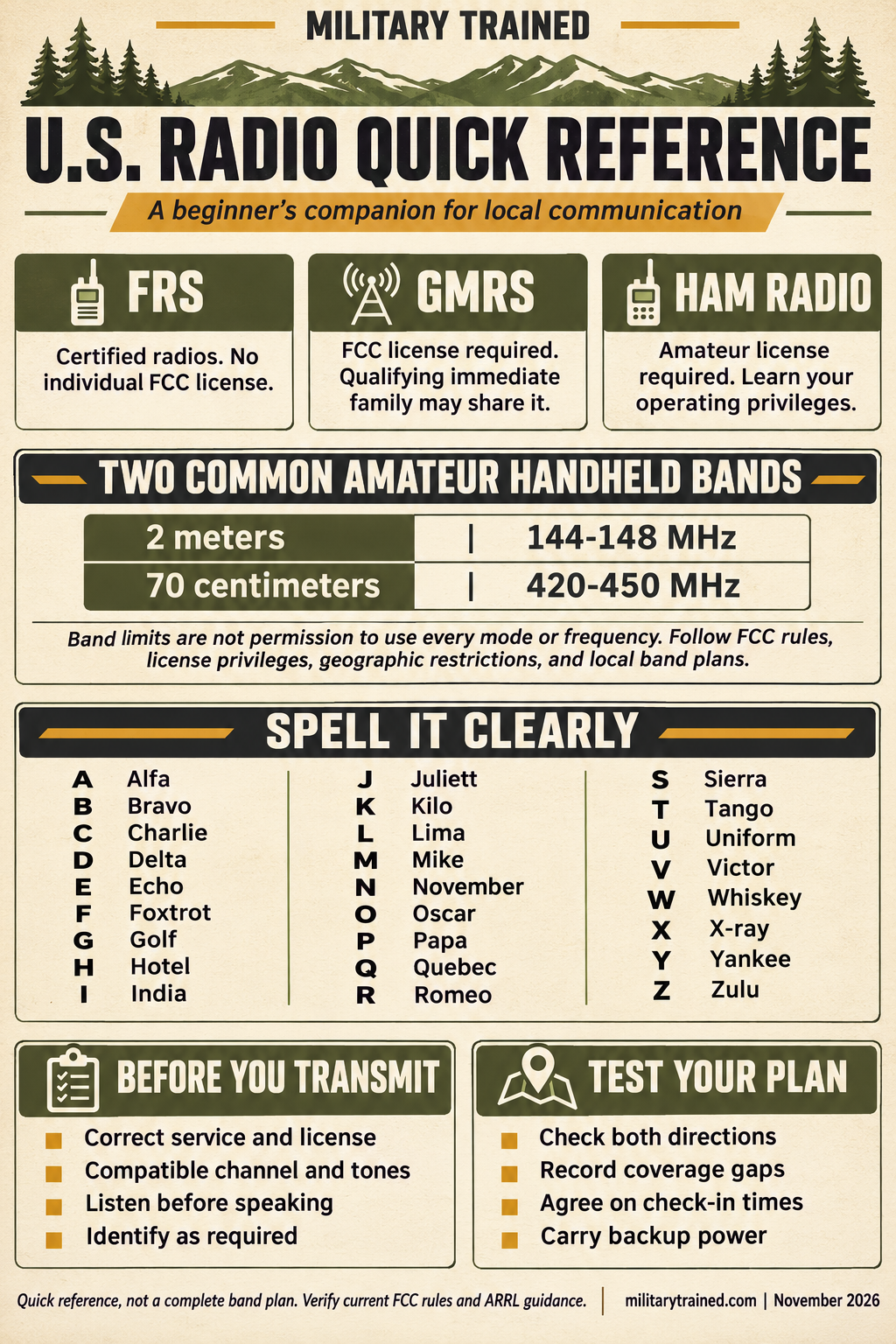
Read the full band plan before programming. The sheet shows U.S. amateur band boundaries of 144-148 MHz for 2 meters and 420-450 MHz for 70 centimeters. Those boundaries do not authorize every mode or frequency. License privileges, FCC rules, geographic restrictions, and local band plans still apply. Use the ARRL frequency guide and band plans for detailed allocations. This sheet is not a complete HF/VHF/UHF band chart.
Text version of the quick reference
Choose your service: FRS uses certified equipment without an individual FCC license. GMRS requires an FCC license and can include qualifying family members. Amateur operation requires a license and must stay within its privileges.
Two common amateur bands: 2 meters: 144-148 MHz. 70 centimeters: 420-450 MHz. Check permitted use and local restrictions before transmitting.
Phonetic alphabet: A Alfa; B Bravo; C Charlie; D Delta; E Echo; F Foxtrot; G Golf; H Hotel; I India; J Juliett; K Kilo; L Lima; M Mike; N November; O Oscar; P Papa; Q Quebec; R Romeo; S Sierra; T Tango; U Uniform; V Victor; W Whiskey; X X-ray; Y Yankee; Z Zulu.
Before transmitting: Confirm lawful operation, agree on compatible settings, listen first, use required identification, check power, and keep calls clear. Test both directions from real locations. Write down check-in times and a fallback plan. Privacy codes are not encryption.
Choose the Setup You Will Actually Practice With
Start with FRS if the job is simple nearby communication. Consider GMRS if your family needs a more expandable local setup and will obtain the required license. Choose ham radio if you want to invest in learning and develop the capability over time.
Buy for the people, terrain, and communication task you have identified. Then prove the setup works in those places. A modest radio with a practiced plan is more useful than an impressive specification sheet sitting unopened in a drawer.
Add your radios, power supplies, and printed contacts to our 72-Hour Emergency Kit Checklist so communication stays part of your household preparations.