How to Build a Geopolitical Threat-Tiered EDC Kit: Everyday Carry Configurations for Economic Disruption and Civil Instability
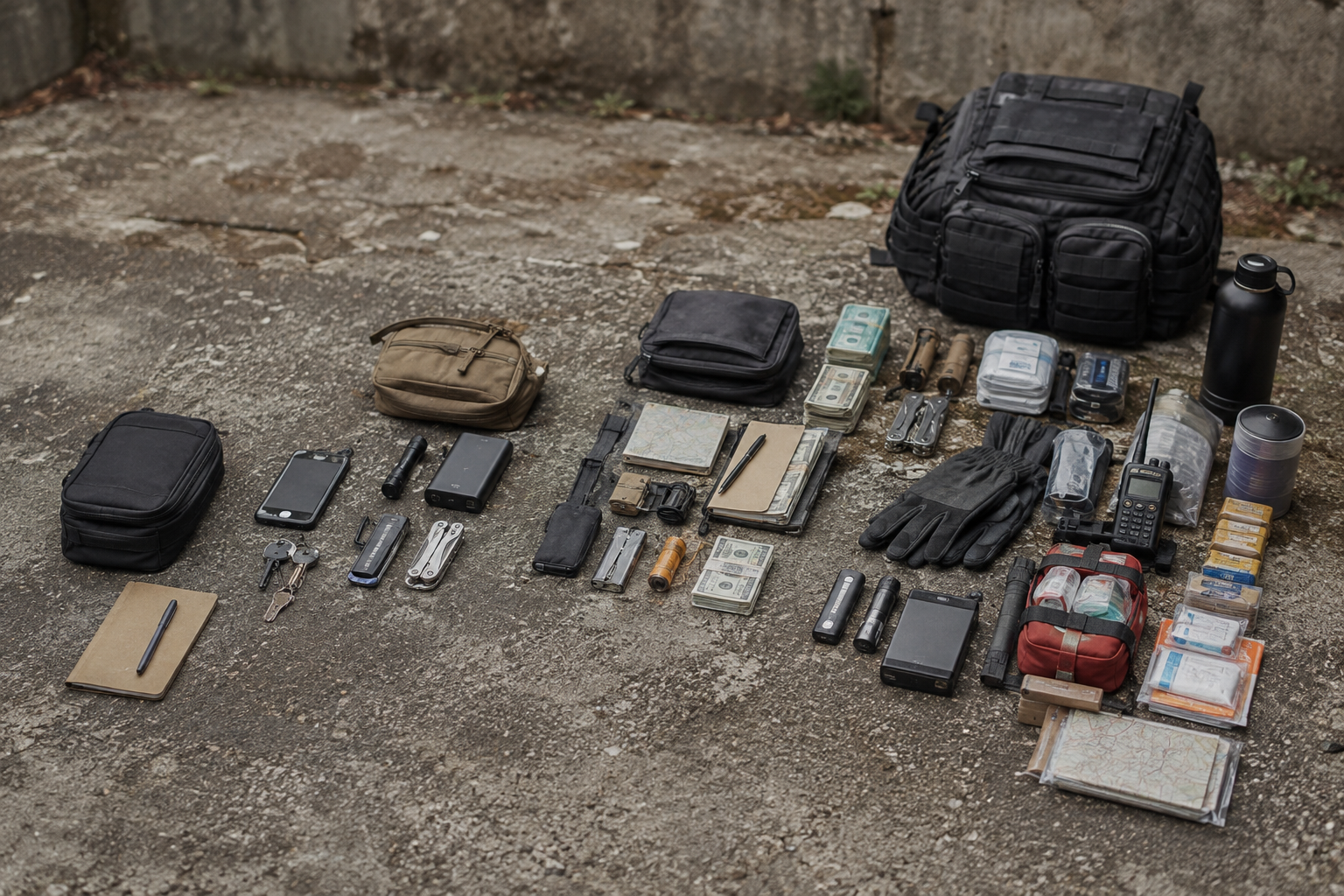
If you already carry an EDC kit and you’re reassessing it in response to economic uncertainty or geopolitical escalation, the answer isn’t to add everything at once. The most practical upgrade is a tiered threat-response model: three modular loadout configurations – Baseline, Elevated, and Acute – that you scale up or down based on daily situational assessment. Each tier builds on the last, so you’re never carrying redundant weight, and every item earns its place against a specific threat vector.
The three tiers below are an editorial organizing tool, not an official threat-alert system or a prediction of civil disorder. Choose supplies for your actual route, local hazards, health needs, and ability to carry them. Peaceful protest or economic uncertainty alone does not establish an immediate danger.
The Three-Tier Threat Model
Use the tiers as practical packing categories, not labels for people or neighborhoods. A routine day may need only basic essentials; a longer trip or a verified disruption may justify additional supplies. Follow current official instructions over this framework.
| Tier | Threat Environment | Carry Priority | Weight Target |
|---|---|---|---|
| Tier 1 – Baseline | Economic disruption, supply chain friction, infrastructure stress | Financial resilience, utility, communication | Weigh your actual load |
| Tier 2 – Elevated | Civil unrest, protest activity, localized disorder | Navigation, self-sufficiency, defensive awareness | Adjust to fit and mobility |
| Tier 3 – Acute | Active crisis, infrastructure failure, forced movement | Water, shelter initiation, medical, navigation | Include water weight |
Each tier is described as an additive layer. Tier 2 assumes you’re carrying everything in Tier 1. Tier 3 assumes both previous tiers are already on your person or in your immediate bag.
Tier 1 – Baseline Economic Disruption Loadout
Tier 1 covers ordinary disruptions such as a dead phone, a delayed trip, or a payment terminal outage. Start with identification, keys, needed medication, a light, contacts, and a tested way to charge your phone.
Financial Resilience Layer
Carry an affordable cash reserve in small bills in a secure wallet or pouch. Cash can help when electronic payments are unavailable, but no payment method guarantees access to supplies. An RFID-blocking wallet is optional, not a preparedness requirement.
If carrying a larger reserve, split it securely between locations so losing one wallet does not mean losing everything. Do not advertise or unnecessarily handle cash in public.
Utility and Communication Layer
A compact multitool can help with routine repairs. Choose the functions you actually use, check its weight, and respect workplace, venue, transport, and local restrictions. A tool is optional; medication and communication needs may matter more.
Choose a portable battery bank and cables compatible with your devices. A 10,000mAh model is one starting option, but usable charges vary with phone size, conversion losses, temperature, and use. Test your actual phone rather than relying on a fixed recharge count.
A small LED flashlight is useful during outages. A lighter is optional and must be stored safely. Never use a flame to investigate a gas leak; leave the area and contact the utility or emergency services from a safe location.
Tier 1 Carry Summary
- Secure wallet with an affordable cash reserve
- Concealed cash carrier or money belt
- Compact multitool (sub-4 oz, pliers-based)
- 10,000 mAh+ portable battery bank
- Mechanical lighter
- Clip-on LED flashlight
Tier 2 – Elevated Civil Instability Loadout
Consider Tier 2 for a longer journey, a known transit interruption, severe weather, or a verified local emergency. Check official alerts and route closures. Avoid dangerous areas rather than assuming additional gear makes entering them safe.
Navigation Independence
Do not rely exclusively on a phone for navigation at Tier 2. Cell networks saturate quickly during civil disturbances as call and data volume spikes. Carry a compact analog compass and paper maps – printed or waterproof map cards – of your city and immediate surrounding region. The goal is to navigate home or to a rally point if your phone dies or the network is unavailable.
Downloaded offline maps can work without mobile data if your phone still has power and receives a position signal. A dedicated GPS may be useful for some trips, but it is optional and also needs power. Carry addresses and a paper route backup.
Optional Cutting Tool
A cutting tool is an optional utility item, not a response to protests or a reason to approach a confrontation. Small scissors or a permitted multitool may cover routine tasks. Check the rules for every destination and transport method; a fixed blade is not a necessary upgrade.
Personal Medical Layer
Carry first-aid supplies matched to your needs and training, including gloves, dressings, and essential medication. Consider genuine bleeding-control equipment after hands-on training. A blanket can reduce heat loss, but it does not treat shock or replace emergency care.
Training matters more than kit contents. Stop the Bleed courses are widely available and free in many areas. A tourniquet carried by someone who has practiced applying it under stress is far more valuable than one carried by someone who hasn’t.
Tier 2 Carry Summary (additive to Tier 1)
- Compact analog compass
- Waterproof paper map of local area and alternate routes
- Compact GPS device (recommended)
- Optional cutting tool permitted at your destinations
- Compact IFAK: tourniquet, hemostatic gauze, gloves, compression bandage, mylar blanket
Tier 3 – Acute Crisis Loadout
Tier 3 is a genuine emergency configuration: infrastructure has failed, you may need to move on foot, and resupply is not available. This tier is not carried daily – it is pre-staged in a small sling bag, chest pack, or expanded belt kit that you grab when threat assessment shifts.
Water Procurement
Carry safe drinking water first. A filter does not turn any fountain or standing water into safe drinking water: typical backpacking filters do not reliably remove viruses or dissolved chemicals. Avoid floodwater and suspected chemical contamination. Follow local advisories and the CDC water-treatment guidance; follow the exact disinfectant label, including contact time.
Shelter Initiation
Choose weather protection for the expected nighttime temperature and conditions. A poncho, tarp, or emergency bivy can be a backup, but cannot guarantee a safe night outdoors. A sleeping-bag liner is not an insulated sleeping bag. Identify a safe destination and do not treat a light emergency cover as a substitute for adequate insulation.
Extended Navigation and Communication
A registered 406MHz personal locator beacon sends a distress alert to search-and-rescue authorities; it is not a routine messaging device. Satellite messengers may support two-way texts with an appropriate service plan and sky view. An AM/FM/NOAA radio receives broadcasts and cannot call for help. These devices serve different purposes. See NOAA beacon guidance and registration instructions.
Caloric Reserve
Carry familiar, shelf-stable food for the expected delay, with extra for contingencies. A 400-600 calorie snack reserve is only a short-term supplement, not adequate nutrition for a full day of strenuous movement. Plan food around individual needs and avoid relying on foraging or fishing.
Tier 3 Carry Summary (additive to Tiers 1 and 2, staged in a grab bag)
- Compact personal water filter (Sawyer Squeeze or equivalent)
- Water purification tablets (chlorine dioxide preferred)
- Collapsible water reservoir or heavy-duty storage bag
- Weather-appropriate insulation; emergency bivy as backup
- 25–50 feet of paracord
- Emergency poncho or compact tarp
- Distress beacon or satellite messenger if appropriate; receive-only radio for alerts
- Food for the planned duration plus an emergency margin
Daily Threat Assessment: Deciding Which Tier to Carry
Use a brief review of local alerts, weather, transport updates, and your planned route. There is no fixed review duration that guarantees readiness.
- Local situational data: Check local news and emergency management feeds for reported civil disturbance, infrastructure disruption, or elevated crime activity in your daily operating area.
- Regional and national indicators: Track one or two reliable geopolitical and economic news sources. You’re looking for trajectory – is the situation stable, deteriorating, or escalating?
- Personal exposure assessment: Where are you going today? A familiar, low-density area warrants Tier 1. Travel through a city center during civil tension warrants Tier 2. Credible reason to believe infrastructure or civil order may fail warrants Tier 3 staging.
The goal is a deliberate, rational decision about your readiness state – not anxiety, and not complacency.
Weight and Budget Discipline
The most common failure mode in EDC upgrades during periods of anxiety is accumulation without architecture. Gear gets added reactively, weight exceeds the comfort threshold, and the loadout gets abandoned. The tiered model prevents this by forcing every item to justify its tier placement. Apply two filters to every potential addition:
- Threat specificity: Which specific threat vector does this item address, and at which tier does that threat become relevant? If you can’t answer clearly, the item doesn’t have a tier assignment and shouldn’t be in the loadout.
- Weight-to-utility ratio: Items addressing multiple threat vectors at low weight earn priority. A multitool can cover several repair tasks; it is not a substitute for medical supplies. A single-function item of equivalent weight is a lower-priority addition.
Prioritize essential daily needs before optional specialist devices. Add equipment when it solves a specific gap in your plan, and budget for training, maintenance, batteries, and any service plan.
Legal and Contextual Carry Considerations
Knife carry laws vary significantly by jurisdiction – blade length limits, fixed versus folding restrictions, and concealed carry rules differ between states, counties, and municipalities in the United States, and vary more sharply internationally. Verify the specific regulations for every jurisdiction you regularly move through before adding a fixed blade, and recheck periodically as laws change.
The tiered EDC model described here does not address firearms carry, which involves a separate and jurisdiction-specific legal framework. If you carry a firearm as part of your existing EDC, that decision and its legal requirements remain independent of the tier system.
Build your carry around the rules of the places you enter. Do not assume a prohibited item may legally or safely be left in a vehicle on the same property. When uncertain, leave it at home and use an allowed alternative.
Integrating the Tiered EDC with Your Broader Preparedness System
The tiered EDC is the innermost ring of a broader preparedness architecture: what you have on your person. Your vehicle kit covers the next ring. Your home stockpile and bug-out bag cover the outer rings.
Keep a grab bag somewhere secure and accessible. Vehicle storage can expose water containers, food, medication, and batteries to damaging temperatures. Follow each item’s storage limits, and do not rely on supplies in a car you may be unable to reach.
Review your tier assignments and gear choices every 90 days, or immediately following any significant shift in your local or regional threat environment. EDC is an ongoing calibration between your assessed risk environment and your daily carry capability – not a one-time configuration.