
- Model
- GXT1000VP4
- Purchase destination
- Midland
- Page type
- Independent field guide
Handheld GMRS field guide
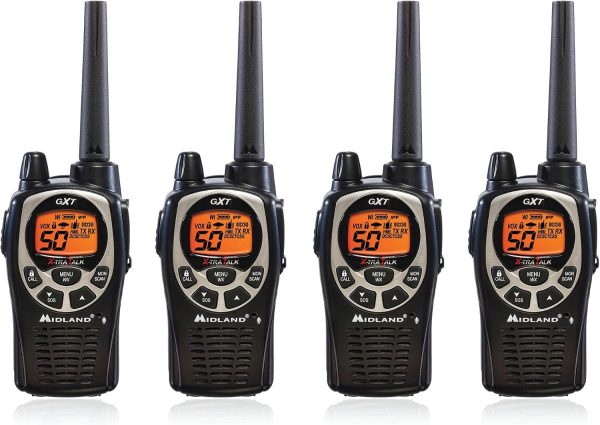
Midland GXT1000VP4 GMRS Walkie Talkie 2-Pack
A complete GMRS handheld pair for trails, family communications and weather-aware preparedness.
The GXT1000VP4 package includes two GMRS handhelds, rechargeable power, a desktop charger and boom-mic headsets. It combines 50 channel choices, NOAA weather alerts and splash resistance in a familiar grab-and-go format.
Two-person teams that want ready-to-use handhelds with weather alerts and useful accessories in the box.
The advertised 36-mile figure is an ideal-conditions maximum. Midland says normal-condition range commonly averages about 0.5 to 2 miles. A GMRS license is required.
Military Trained may earn a commission from this link.
Fast decision layer
At a Glance
The numbers that explain the product before you leave for the retailer.
Radios in the pack
A matched pair with charging and audio accessories.
Channel choices
22 standard channels plus 28 additional channels.
Privacy codes
Up to 3,124 channel and privacy-code combinations.
Water resistance
Protection against light rain and splashing, not submersion.
Use-case filter
Mission Fit
Start with the job, environment and team before deciding whether the radio format fits.
Strong fit
Trail groups and campsites
The two-radio pack gives a pair of users portable voice communication without installing equipment in a vehicle.
Strong fit
Family and preparedness kits
Rechargeable batteries, charging hardware, NOAA alerts and an SOS siren cover several practical readiness needs.
Consider another format
Long-range vehicle or repeater work
A higher-power mobile radio with an external antenna is the better fit when vehicle installation and repeater access matter most.
Portable communications in practice
Where a Two-Radio Handheld Kit Earns Its Place
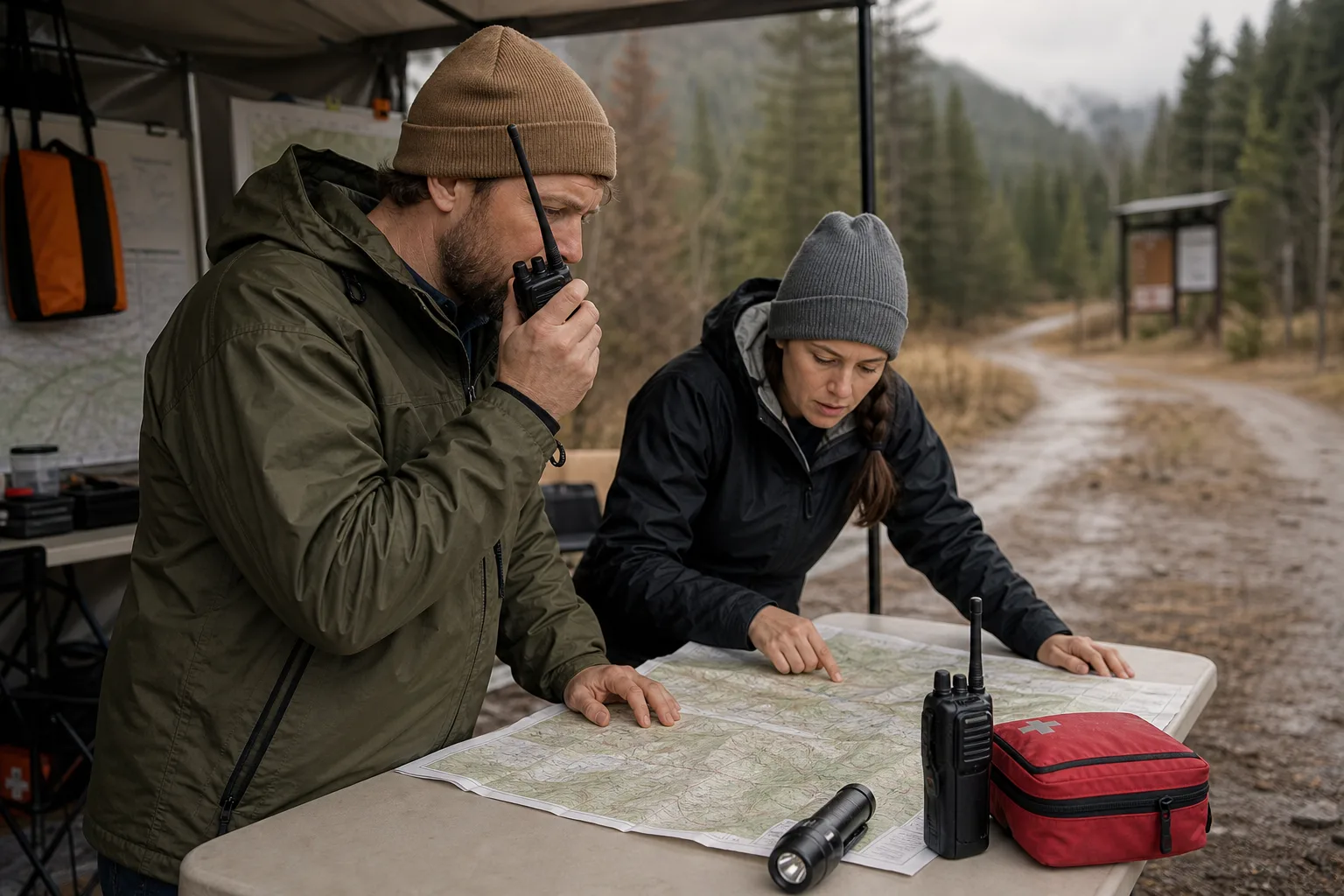
Handheld radios are valuable because they stay with the people doing the work. The GXT1000VP4 package gives two users a matched channel set, rechargeable power and headsets without a vehicle installation. Its practical value comes from a clear communications plan and terrain-aware expectations, not from treating the 36-mile headline as an everyday promise.
Trailhead, campsite and group movement
Give the lead and rear members of a small group one radio each, then agree on check-in points before the trail separates. The handheld format works while walking, setting camp or moving between vehicles, but terrain folds and dense vegetation can shorten range quickly.
Household preparedness and reunification
A pair can support short-distance coordination around a neighborhood, evacuation loading point or family meeting area when cellular service is congested. Store the radios charged, write the primary and alternate channels into the family plan and practice before severe weather arrives.
Property, event and volunteer coordination
The included headsets can help users keep their hands available during farm tasks, event setup or a volunteer exercise. For routine non-family operation, every participant should confirm the licensing authority that applies to them instead of assuming one household license covers an organization.
What the specs mean
Field Breakdown
A practical reading of the headline features, without treating ideal-condition claims as guaranteed performance.
-
01
Plan around realistic range
The 36-mile rating assumes exceptional line of sight. Midland reports roughly 0.5 to 2 miles as a normal-condition average, with terrain and obstructions changing the result.
-
02
Weather-aware operation
NOAA Weather Scan finds a local broadcast, and Weather Alert can warn the group when severe conditions are reported.
-
03
Splash resistant, not submersible
JIS4 protection is appropriate for light rain and splashing. It should not be treated as an IP67-style waterproof radio.
-
04
FRS interoperability
On channels 8 through 14, the GXT series drops to FRS power so it can communicate with compatible FRS handhelds on the same channel.
Fact-checked against Midland documentation on August 20, 2026. This guide explains manufacturer-listed specifications and is not a hands-on range test.
Before first use
A Four-Step GXT1000VP4 Readiness Plan
A radio in a drawer is not yet a communications capability. Charge, configure and test the pair as a system before it becomes part of a trail, household or storm plan.
-
01
Confirm license coverage
Obtain the required FCC GMRS license before routine transmission and identify who may operate under it. An individual license can cover immediate family members. Friends, volunteers and coworkers should confirm their own operating authority rather than relying on a household license that does not cover them.
-
02
Prepare primary and backup power
Fully charge both supplied battery packs and confirm the desktop charger, AC adapter and vehicle DC adapter work. If alkaline batteries are part of the backup plan, fit the correct type described by Midland and store them separately so old cells cannot leak inside a radio.
-
03
Match every channel setting
Choose one primary channel and one alternate, then set the same privacy code on both radios. Privacy codes reduce unwanted audio but do not encrypt a conversation. Label the plan in plain language so another family member can restore the settings without guessing through menus.
-
04
Test the actual route
Walk or drive the places where the radios are expected to work and record the dead zones. Test from inside buildings and vehicles as well as outside. Establish a missed-check-in action, because repeating calls from the same blocked location is not a complete fallback procedure.
Technical checklist
Specifications That Matter
- Two GXT1000VP4 GMRS handheld radios
- 22 standard channels plus 28 additional channels
- 142 privacy codes
- JIS4 resistance to light rain and splashing
- NOAA Weather Scan and Weather Alert
- SOS siren and 10 call alerts
- Rechargeable battery packs with alkaline-battery fallback
- Three-year manufacturer warranty
- Radio dimensions: 2.44 x 7.91 x 1.52 inches
Make the right choice
Is This Handheld Pair Enough for the Job?
The GXT1000VP4 is an accessible way to equip two people, but range, water exposure and the need for vehicle coverage should decide whether it is the primary radio or one layer in a larger system.
Choose the GXT1000VP4
Two people need portable radios now
The package is a strong fit when you need a matched pair, charging options and headsets in one box. It avoids installation work and lets both operators communicate after leaving the vehicle, campsite or base location.
Set realistic expectations
Normal terrain is not a 36-mile test range
Midland describes 36 miles as an open-area, low-obstruction maximum and reports about 0.5 to 2 miles as a normal-condition average. Buildings, ridges, foliage and carrying the antenna close to the body can reduce useful distance.
Choose a tougher handheld
Submersion or harsher exposure is likely
JIS4 covers light rain and splashing, not immersion. Boating, repeated heavy weather or work where a radio may be dropped into water calls for a model with a clearly stated submersion rating and a retention method suited to that environment.
Add a mobile radio
A vehicle must cover a wider area
A mobile GMRS radio with an external antenna is usually the stronger foundation for regular vehicle-to-vehicle or property-wide communication. The handheld pair can then serve foot teams while the mobile-equipped vehicle remains the higher-powered coordination point.
Buyer intelligence
Questions That Decide the Purchase
Range claims, licensing, compatibility and operating details translated into direct buying answers.
Straight answer
Will these radios really reach 36 miles?
Only in unusually clear line-of-sight conditions, such as mountaintop to mountaintop. Midland says the GXT series averages about 0.5 to 2 miles in normal conditions.
Straight answer
Are they waterproof?
They are JIS4 water resistant, which covers light rain and splashing from any direction. They are not designed for submersion.
Straight answer
Do they require a license?
Yes. These are GMRS radios, and a valid FCC GMRS license is required to transmit on GMRS.
Straight answer
Can they talk to FRS radios?
Yes, on compatible shared channels and settings. Midland specifically notes FRS-power operation on channels 8 through 14.
Straight answer
What do the 142 privacy codes actually do?
They let the speaker ignore transmissions that do not carry the selected CTCSS or DCS code. They do not create a private or encrypted channel, and another radio can still monitor the underlying frequency. Both radios in your group need matching channel and code settings.
Straight answer
Can the GXT1000VP4 use a repeater?
Midland does not list repeater operation among the GXT1000VP4 features. If repeater access is a core requirement, choose a model that explicitly supports GMRS repeater channels and the tone configuration used by the system you intend to access.
Straight answer
What happens if the rechargeable packs run down?
The package supports an alkaline-battery fallback when the correct cells and battery arrangement described by Midland are used. Test that backup before a trip, keep spare cells dry and do not mix old and new batteries or different battery types.
Straight answer
Does NOAA Weather Alert replace phone alerts or a weather radio?
No. It adds another way to receive local weather information, but reception depends on location and power. Use multiple warning methods and keep a plan for what the group will do after an alert, rather than relying on the alert feature alone.
Ready to equip the team
Midland GXT1000VP4 GMRS Walkie Talkie 2-Pack
If the radio matches the job and the rest of your communications plan, check the available configuration and put it to work.
Military Trained may earn a commission from this link.