How to Create an Emergency Plan for Your Family: A Step-by-Step Guide

The Military Approach to Family Preparedness
Military units do not wait for an emergency to figure out what to do. They plan before the threat arrives, assign roles before confusion sets in, rehearse before stress degrades decision-making, and maintain equipment before it’s needed. The result is that when something goes wrong — and it will — the response is not improvised. It’s executed.
Civilian family preparedness follows exactly the same logic. The difference between a family that weathers a hurricane or extended power outage with manageable difficulty and one that faces a genuine crisis is almost never luck. It’s planning done in advance, practiced while calm, and maintained while nothing seems urgent.
This guide builds a complete family emergency framework: hazard identification, home vulnerability audit, communication protocol, 72-hour kit by category, evacuation roles, and a maintenance schedule that keeps the plan current. Work through each section, document your decisions, and put the plan somewhere every family member can find it without power.
The four-phase planning model:
— Identify: What emergencies are most likely in your area, and what does each one demand?
— Prepare: What gear, documentation, and stored resources does your family need for 72 hours?
— Plan: Where do you go, who does what, and how do you communicate if separated?
— Practice: When and how often does the family drill the plan, and when does the plan get updated?
A plan that exists only on paper is not a plan. It’s a document.
Hazard Identification: Know Your Threat Profile Before You Build Your Plan
Emergency preparedness is not generic. A family in coastal Florida prepares differently than one in California’s earthquake country or Minnesota’s blizzard corridor. The shape of your plan — what you stock, where you go, how long you need to be self-sufficient — is determined by the specific emergencies most likely to affect your location. Start with your actual threat profile, not a generic list.
Your local emergency management office (search “[your county] emergency management”) publishes hazard mitigation plans that identify the specific threats in your area ranked by probability and consequence. FEMA’s Hazard Mitigation Planning resource and the National Weather Service’s local forecast office are additional starting points. Use these before you begin planning.
- Flash flooding, river flooding, storm surge
- Hurricanes and tropical storms
- Tornadoes, severe thunderstorms
- Ice storms, blizzards, extreme cold
- Earthquakes and aftershock sequences
- Wildfire and evacuations under smoke
- Landslides, mudflows, volcanic activity
- Drought-driven utility disruption
- Extended power outages (2–14+ days)
- Water treatment or distribution failure
- Natural gas disruption in cold weather
- Internet and communications blackout
- Industrial chemical spill or release
- Transportation hazmat incident
- Civil unrest, shelter-in-place orders
- Pandemic or public health emergency
Evaluating your home’s vulnerability
Knowing what threats exist is half the audit. The other half is understanding how your specific home and property respond to each threat. A structural weakness you haven’t identified is a hazard you cannot plan around. Conduct a walk-through of your home with this checklist before finalizing any preparedness decisions.
-
□// StructureSmoke and CO detectors tested. One per floor, within 10 feet of every sleeping area. Batteries replaced within 12 months.
-
□// StructureFire extinguishers located and charged. Kitchen, garage, and one additional accessible location. Every adult family member knows how to operate one.
-
□// StructureHeavy furniture and appliances secured. Bookcases, water heaters, and large appliances strapped to wall studs — critical in earthquake-prone areas.
-
□// UtilityMain shutoffs located and operable. Every adult knows the location and operation of the water main, gas shutoff, and electrical main breaker.
-
□// UtilityGenerator or backup power staged. If applicable — properly vented, fuel stored, transfer procedures understood to prevent backfeed injuries.
-
□// ShelterInterior shelter room identified. For tornado or severe weather — an interior room on the lowest floor, away from windows. Reinforced or not, its location must be known by everyone.
-
□// ShelterFlood risk assessed for your specific address. Check FEMA’s flood map (msc.fema.gov) to confirm your flood zone designation. Know your property’s base flood elevation.
-
□// DocumentsCritical documents copied and stored off-site or in a waterproof container. IDs, insurance policies, prescriptions, medical records, deed/lease, financial account numbers.
Communication Protocol: How Your Family Reconnects When Separated
Cell networks become congested or fail entirely during major emergencies — towers lose power, traffic spikes beyond capacity, and the people who need to reach each other cannot. A family communication plan assumes technology may be unavailable and builds redundancy: multiple contact methods, pre-designated physical locations, and a single out-of-area contact who serves as the coordination point if local communications are down.
- Primary: A specific location immediately outside the home — a neighbor’s driveway, a mailbox, a corner — used when evacuating from fire or immediate home emergency
- Secondary: A location outside the immediate neighborhood — a school, library, or community center — used when the neighborhood is inaccessible or under evacuation order
- Regional: A location outside the city or region — a relative’s home — for widespread disasters requiring extended displacement
- All locations must be known to every family member old enough to travel independently
- Designate one person outside your region who will serve as the coordination hub
- Every separated family member calls or texts this person first — they relay information to other family members and track who has checked in
- This person must be briefed on their role in advance and must agree to it
- Their number is memorized or written on a card in every wallet — not only saved in a phone that may be dead
- Text messages often succeed when voice calls cannot — text is lower bandwidth and holds in queue longer
- NOAA Weather Radio with battery backup — receives emergency alerts without internet
- Wireless Emergency Alert (WEA) system pushes to cell phones automatically
- Local emergency alert apps (e.g., Everbridge, AlertMedia) registered for your county
- Social media check-in: Facebook Safety Check activates automatically in major disasters
- Assumption: all digital systems may be unavailable. Treat this tier as a supplement only.
- Hand-crank or solar-powered emergency radio for NOAA and local broadcast
- Physical contact information card in every wallet, backpack, and go-bag
- Pre-agreed written note at the home location: where you went, when, your contact number
- FRS/GMRS walkie-talkies for family members within range during neighborhood emergencies
- Community radio monitoring (AM 1630 or local emergency frequency) for official broadcasts
Run a communications drill at least once a year. During the drill, treat all digital methods as unavailable. Every family member attempts to reach the out-of-area contact using only a physical phone number list. Identify which family members don’t have the contact memorized or written down, and fix that gap during the drill — not during an actual emergency.
The 72-Hour Kit: What You Need, Organized by Category
Seventy-two hours is the planning baseline recommended by FEMA and most emergency management agencies — the window between a disaster and when external support typically begins to arrive and become organized. Your kit covers this window for every family member without resupply. Items marked with ◈ are critical priorities — address these before anything else.
Stage two kits, not one. A large shelter-in-place kit (cabinets, closet, garage) for extended home-based emergencies, and a compact go-bag per family member for evacuation scenarios. The go-bag is sized for what one person can carry for 72 hours — not everything in the house kit. Many families prepare neither because the combined task feels overwhelming. Two separate, purpose-built kits are easier to maintain and more operationally useful.
Meeting Points and Evacuation Routes: The Physical Plan
A family that can’t find each other has no plan, regardless of how well-stocked their kit is. Physical meeting points must be specific — not “the park,” but “the bench at the northwest corner of Henderson Park near the water fountain.” Not “school,” but “the flagpole in front of the main entrance on Elm Street side.” Vague designations fail under stress when multiple interpretations are possible.
Mapping home evacuation routes
Draw a floor plan of your home — it does not need to be architectural, only functional. Mark every room and every exit from each room, including windows. Every room must have at least two possible egress paths. In bedrooms, this is especially critical: a child who wakes to smoke and finds the door hot must know to exit through the window and where to meet.
Mark the primary route from each room to the exterior, and a secondary route assuming the primary is blocked. Post a simplified version of this plan (bedrooms and egress arrows) somewhere visible in hallways. Practice evacuation from each room at least twice a year, including at least one night drill — most residential fire deaths happen at night.
Vehicle evacuation routes
For area-wide evacuations (hurricane, wildfire, chemical spill), know at least two vehicle routes out of your immediate area in different directions. One primary route and one alternate — because the primary route will be congested and may be blocked. Identify the first decision point (typically a major intersection) where you determine which route to take based on actual conditions, and agree on that decision point in advance so a separated family member making independent decisions chooses the same fork.
Evacuation Roles: Assign Tasks Before Chaos Does
Role assignment is the difference between a coordinated evacuation and six people grabbing random things while blocking each other in the hallway. Assign roles based on capability, not preference. Document the assignments. Practice them. When the smoke alarm goes off at 0200, the assigned role executes automatically — nobody has to think about who is doing what.
- Calls the evacuation and gives the order
- Grabs the go-bag and critical document container
- Confirms headcount at primary meeting point
- Makes the go/stay decision based on conditions
- Contacts out-of-area relay person after initial safety
- Confirms all children and vulnerable family members are out
- Carries secondary go-bag and medical kit
- Controls pets — leash, carrier, pet kit
- Shuts off gas if trained and safe to do so
- Drives if team leader is managing children
- Grab their own pre-packed bag and shoes
- Move directly to primary meeting point — do not wait
- Assist younger siblings if safe to do so
- Know the out-of-area contact number by memory
- Do not go back inside for any reason without adult authorization
Personalize the role assignments for your specific family composition — single-parent households, multi-generational families, family members with mobility limitations, and households with infants all require different role structures. The framework above is a starting point. The operative rule is that every task has a named owner before the emergency happens.
Never go back inside a burning structure for possessions. Structure fires move faster than most people expect — a room flashovers in as little as three to five minutes from ignition. Material possessions are replaceable. Assign one person to the go-bag precisely so that no one has a reason to re-enter. The bag is already outside before anyone enters that calculation.
Special Needs Planning: Accounting for Every Family Member
A generic emergency plan fails anyone whose needs fall outside the generic. Build accommodation for every family member’s specific requirements into the plan before an emergency, not during one.
Family members with disabilities or medical needs
Ensure all evacuation routes are physically accessible for family members with mobility limitations — including windows in bedrooms, which standard egress plans often overlook. For family members with sensory disabilities, physical alert systems (bed shakers for fire alarms, visual strobes) may be necessary. Pre-register with your local emergency management office as a household with access and functional needs — many jurisdictions maintain lists for priority welfare checks and accessible transportation during evacuations.
For family members dependent on powered medical equipment, contact your utility company about their medical baseline program, which may include priority restoration. Identify a backup power solution (battery backup, generator) sized to run the equipment for a minimum of 72 hours, and include that calculation in your emergency kit planning.
Pets and working animals
Most public emergency shelters do not accept pets. This is not a detail to discover during evacuation. Identify in advance: pet-friendly hotels along your evacuation routes, a veterinarian or boarding facility outside your immediate area who can take your animals on short notice, and whether any family members in your extended network can receive your pets. A pet emergency kit — food, water, medications, vaccination records, leash, crate, and a current photograph for identification — should be staged alongside your family’s go-bags.
Keeping the Plan Current: Maintenance Schedule
An emergency plan has a shelf life. Phone numbers change. Children grow into different roles. Prescriptions change. Food and water expire. A plan that was accurate eighteen months ago and has not been reviewed since may have critical gaps that only surface under pressure. Build review into the calendar — it does not happen spontaneously.
| Frequency | Review Task |
|---|---|
| // Monthly | Battery check — flashlights, smoke detectors, CO detectors, emergency radio. Test fire alarms. Confirm go-bags are in their designated location. |
| // Quarterly | Water rotation — replace stored water in containers not commercially sealed. Inspect stored food for damage or spoilage. Restock anything consumed or depleted. |
| // Semi-Annual | Full plan review — update contact numbers, revise meeting points if family circumstances changed, review evacuation routes, run a family drill covering both shelter-in-place and evacuation scenarios. |
| // Annually | Kit refresh — replace all food and medications approaching expiration. Recheck clothing sizes for children. Update document copies (new IDs, updated insurance, changed financial accounts). Assess whether local hazard profile has changed. |
| // After Any Event | Debrief — after any emergency (even minor ones), identify what the plan got right, what it missed, and what needed improvisation. Update the plan based on actual experience before the next event. |
Schedule the semi-annual review on dates you’ll remember:
— March / September — six months apart, easy to recall
— Or tie to Daylight Saving Time changes — already a reminder to replace smoke detector batteries
A calendar reminder set now is worth more than good intentions that never produce a review date.
Compare Products: 72-Hour Kit, Emergency Radio, and Full Family System
Three products that address the core equipment gaps in most family emergency plans: a pre-built 72-hour kit for rapid baseline preparedness, a hand-crank NOAA emergency radio for communications independence, and a comprehensive family system for households that want professional-grade coverage.
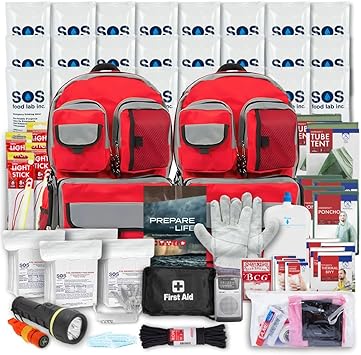
- Price$79.99
- Coverage4 persons / 72 hours
- FormatGo-bag / backpack
- Food Included✓ Yes
- Water Included✓ Yes
- First Aid✓ Yes
- NOAA RadioNot included
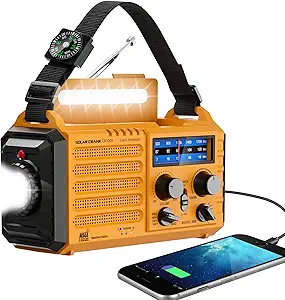
- Price$49.67
- Battery5000mAh built-in
- Power InputsSolar · Crank · USB-C
- NOAA Alerts✓ Yes
- AM/FM✓ Yes
- USB Out✓ Phone charging
- Requires GridNo — fully off-grid
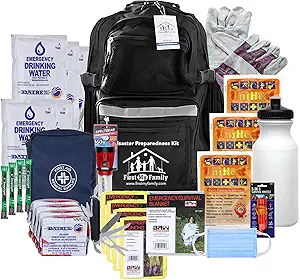
- Price$199.95
- Coverage4 persons / 72 hours
- Brand FocusDisaster preparedness
- All-in-One✓ Comprehensive
- Food & Water✓ Included
- Build QualityPremium
- CustomizableSupplement as needed
- Food, water, first aid included
- Go-bag format — portable
- Supplement with RX and documents
- NOAA weather alert reception
- 5000mAh USB charging output
- Solar + crank + USB-C input
- All-in-one 4-person coverage
- Premium build quality
- Supplement with medical specifics
- Scepter · Aqua-Tainer · WaterBOB
- BPA-free, food-grade HDPE
- Stack and store in cool dark location
- Adventure Medical Kits Trauma Pak
- NAR SOFTT-W tourniquet
- QuikClot hemostatic gauze
- Anker 26800mAh portable battery
- Goal Zero Sherpa 100AC
- BigBlue 28W foldable solar panel