Axe, Hatchet, and Folding Saw Skills for Survival: Safe Bucking, Splitting, Limbing, and Field Sharpening Without Injuries
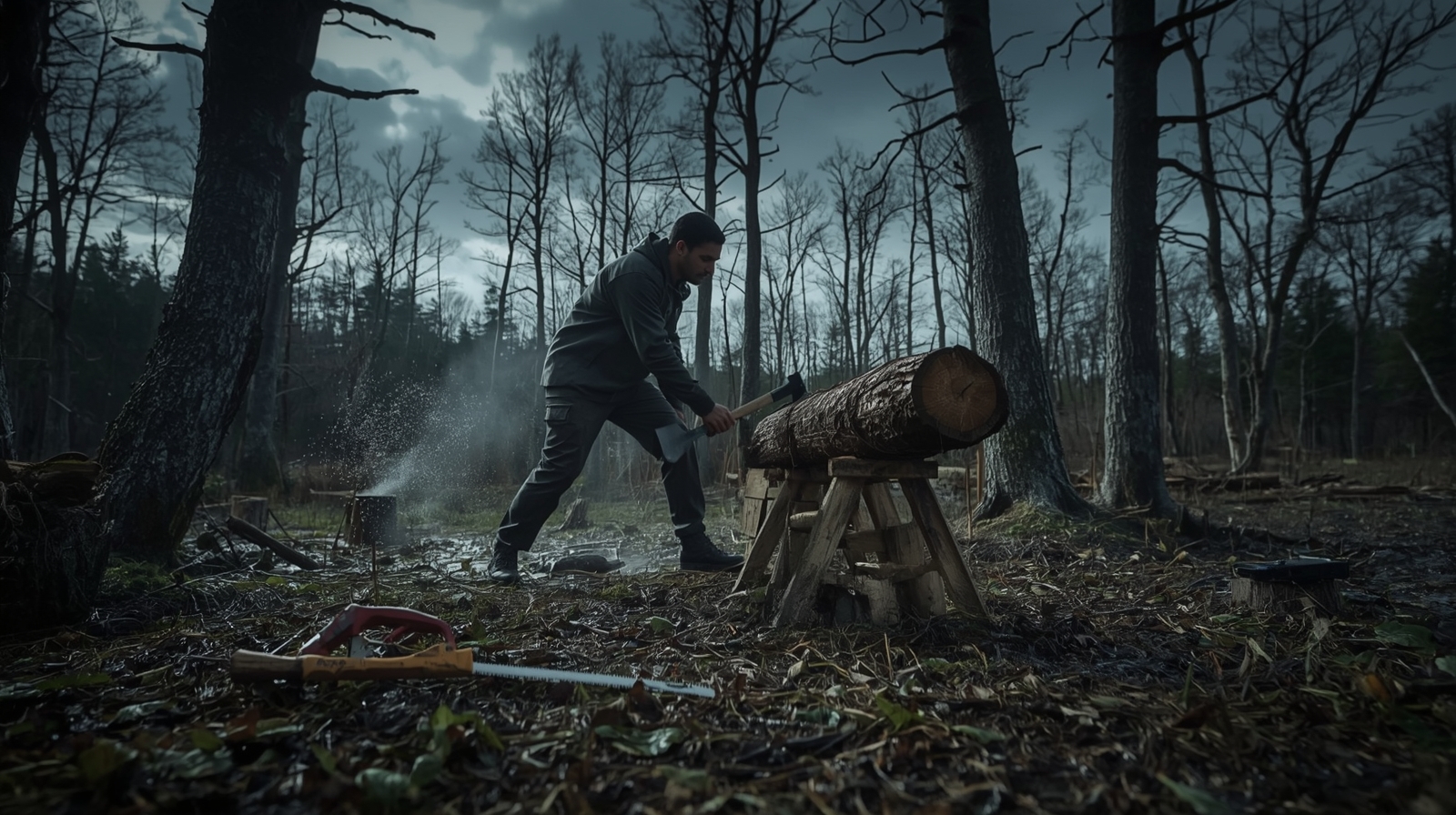
Tool work starts with a safety system, not a swing
Wood processing isn’t glamorous, but it’s one of the fastest ways to either stabilize your situation or end your trip. Most tool injuries don’t come from “bad luck.” They come from skipped controls: poor footing, a dull edge, rushing, or working in the wrong spot.
The goal is simple: build repeatable axe, hatchet, and folding saw habits that keep your hands, shins, and knees intact while you buck, limb, split, and maintain your tools. Treat these skills like a system, not a set of tricks. You’ll work faster, and you’ll stay safer.
Your risk picture changes when you’re cold, tired, or alone
If you’ve spent time in the military, you already understand this principle: the task doesn’t exist in a vacuum. Weather, fatigue, time pressure, and isolation stack risk fast.
Wood processing often happens at the end of the day. That’s when your hands are clumsy and your judgment gets optimistic. It’s also when you’re most likely to say, “Just one more cut.”
Run a quick deliberate risk assessment before you start. Ask yourself:
- Where is the nearest medical help?
- How slick is the ground?
- How’s your grip strength with gloves on?
- Are you hungry, shaky, or racing daylight?
If you’re already shivering or racing daylight, choose the tool and technique with the lowest injury cost — even if it burns a few more calories. A folding saw is almost always safer than an axe at the end of a hard day.
If you’re building a fire in harsh conditions, have your stove plan squared away so you’re not forcing risky wood work just to get water hot. This pairs well with cold-weather stove and fuel management as a “don’t bet your life on one heat source” mindset.
Establish a work zone and a stop rule
Before you cut anything, build a simple work zone. You want stable footing, no tripping hazards, and zero people inside your tool arc.
In a team, that means spacing and clear communication. Solo, it means you do not work next to the tent, next to your cook setup, or on top of your gear.
Use a stop rule: if you can’t maintain stable footing and controlled breathing, you stop. Not “after this last cut.” You stop right there. Most injuries happen on the “one more swing” decision.
No-injuries baseline — quick reference:
— Stable feet on stable ground
— Clear tool arc and no one inside it
— Sharp edge, tight head, solid handle
— Controlled tempo (no rushed swings)
— Stop immediately if you lose control or focus
Choosing the right tool: axe, hatchet, or folding saw
Picking a tool because it “feels outdoorsy” is how you end up chopping at knee height with a hatchet on wet ground. Instead, match the tool to your tasks, your environment, and your energy level.
Think of this section as your decision filter. Once you choose the right tool, your technique gets simpler and your risk drops.
Think in tasks: bucking, limbing, splitting, and carving
In practical survival use, you’re usually doing some combination of the following:
- Bucking: cutting logs to length
- Limbing: removing branches from a downed trunk
- Splitting: turning rounds into kindling and stove-sized pieces
- Shaping: feather sticks, stakes, notches, and light carpentry
A folding saw is often the safest bucking tool. An axe is usually the most efficient splitting tool. A hatchet sits in the middle — it’s portable and versatile, but it’s also easy to misuse because it tempts you into one-handed, sloppy work.
Traveling light? A folding saw plus a small hatchet covers most realistic field needs. If you’re stationary — base camp, winter camp — a full-length axe earns its weight.
A practical comparison table you can use in the field
| Tool | Best At | Weak At | Safety Edge | Watch For |
|---|---|---|---|---|
| Axe (24–28 in.) | Splitting rounds, heavy limbing, fast bucking on large wood | Fine carving, tight spaces | More reach = more momentum control (if used correctly) | Glancing blows, over-swinging, foot/leg line |
| Hatchet (12–16 in.) | Kindling, small limbing, light splitting | Big rounds, long bucking sessions | Compact, easier to stow | One-handed swings, wristy strikes, misses near knees |
| Folding Saw | Bucking cleanly, controlled cuts, quiet processing | Splitting, heavy limb removal | Lowest “catastrophic strike” risk | Blade pinch, broken tips, cutting too close to body |
Pre-use checks and safe carry: prevent failures before they start
Tool failures are rarely surprises. Heads loosen, edges dull, and people carry tools unsafely because it’s “just for a minute.” The fix is a short, repeatable pre-use routine. This is one of those military habits that transfers perfectly: inspect, then execute.
The three checks: tight, sharp, and sheathed
Do these three checks every time you pull your tool out:
- Tight — Axe/hatchet head seated, not rocking. Handle free of cracks. Folding saw pivot screw snug.
- Sharp — Axe/hatchet edge bites wood without skating. Saw teeth grab without excessive pressure.
- Sheathed — If you’re not actively cutting, the edge is covered or the saw is folded. No exceptions.
A loose axe head is a mission-ending hazard. In remote terrain, a thrown head can injure you — or it can vanish into brush when you need it most. Check every time, without exception.
Body mechanics: your legs are not a backstop
Most serious axe/hatchet injuries are lower-body strikes. The fix isn’t “be careful.” The fix is building a stance where a miss can’t reach you.
Use a staggered stance with your lead foot back far enough that the edge can’t reach your shin if it passes through the work. Keep your knees slightly bent so you can absorb small slips without collapsing into the swing.
When splitting, kneel only if you can guarantee the edge stops in a block and not your thigh. If you can’t guarantee that, don’t kneel.
It’s also smart to integrate eye protection into your routine — wood chips and snapped twigs are constant. For a practical system around eye problems and debris, see snow blindness, dust, and debris eye protection.
Folding saw fundamentals: safe bucking with clean kerfs
A folding saw is your precision tool for turning long pieces into stove lengths or fire lay lengths. It’s also the tool most people underuse because it feels slower. In reality, a saw often saves time because it reduces misses, reduces edge damage, and produces cleaner cuts with less drama.
Bucking without pinching the blade
Your main enemy is pinch — where the kerf closes and traps the blade. Start by reading the log’s support points:
- Supported at both ends (like a bridge): the kerf often closes on top as you cut down.
- Supported in the middle: the kerf often closes on the bottom.
Fix pinch before it happens. Cut from the side that opens the kerf, or insert a small wedge or stick to keep the cut open. Use long strokes and let the teeth do the work. Keep your off-hand well away from the cut line. If you need to stabilize the log, do it with your boot on the far side of the blade path, not behind it.
Blade pinch fix: If the saw binds mid-cut, don’t yank. Insert a twig or your thumb to open the kerf slightly, then resume with a lighter stroke. Yanking torques the blade and snaps tips.
Limbing with a saw when the branches are spring-loaded
Saw limbing is underrated because it’s controlled and quiet. The hazard is tension: branches can be bent under load, and the moment you cut, they whip.
Before you cut, look for compression and tension zones. If a limb is bent downward, the top fibers are in tension and the bottom is in compression. A clean approach:
- Make a small relief cut on the compression side first.
- Finish the cut from the tension side to prevent tearing and sudden release.
Keep your face out of the snap line. If a loaded limb releases suddenly, you want it to move past you — not into your face. Position yourself to the side, never directly in the plane of movement.
Axe and hatchet bucking: when chopping is the right move
Chopping to length with an axe or hatchet can be efficient when wood is too thick for your folding saw, your saw is dull, or you need speed. The price of that speed is higher consequence — which means your setup has to be cleaner.
Set the log, don’t fight it
The key is to set the log so the cut finishes into air — not dirt and not your foot. A simple, reliable setup is to lift the log with two support sticks. This does three things:
- Protects your edge from dirt and rocks
- Reduces bounce and unpredictable deflection
- Gives you clearance for the final separation
If you can’t lift it, cut slightly off the ground on the side where the wood can drop away as it severs. Aim for a V-notch from both sides rather than trying to power straight through from one side. It reduces binding and gives you better control over the final break.
Chop geometry that prevents glancing blows
Glancing blows come from poor bite angle or striking near knots. You want the bit to enter the wood at a consistent angle, not skate across it. Use a controlled, shoulder-driven swing. Avoid wrist-only “snap” swings that feel fast but reduce accuracy.
If you’re using a hatchet, choke up near the head for accuracy. Use shorter, deliberate strokes.
Accuracy drill: Mark a line on the end grain with charcoal. Make ten light strikes trying to hit that line — not ten heavy strikes trying to “finish the cut.” Precision saves energy and skin.
Limbing with an axe or hatchet without shredding your legs
Limbing is where people get casual and get hurt. The trunk rolls, branches are springy, and you’re striking at awkward angles. The goal is to keep wood between you and the edge, and to avoid any swing path that could reach your legs if you miss.
Work from the base toward the top and keep the trunk between you and the edge
Start at the base and work toward the top so you’re not stepping over sharp stubs. Whenever possible, keep the trunk between your legs and the cutting action. A reliable position:
- Branch on the far side of the trunk
- Swinging down and away
- Feet stable, not straddling the work
If you can’t get that geometry, switch to the saw. There’s no prize for “axe-only” limbing in a survival scenario. Use the tool that keeps you safe.
Use “two-cut” thinking on thick or loaded limbs
For limbs thicker than your wrist or under obvious tension, use “two-cut” thinking. First, make a small scoring cut to establish the bite and prevent the bit from sliding. Then commit to the removal cut with a clear escape path for the limb.
If the limb is under tension, consider the folding saw for a slower, safer release. Watch for dead, dry branches that shatter — when they explode, they throw sharp fragments. This is another reason eye protection and a controlled tempo matter.
Splitting wood: controlled power for kindling and fuel
Splitting is where an axe shines — but only if you set up correctly. If you set up poorly, splitting is where glancing blows and foot strikes happen. The big idea: make the wood and the ground work for you.
Choose the right splitting setup: block, stance, and target size
Your best friend is a splitting block: a wide, stable round that keeps your target off the ground and gives the edge somewhere safe to land. Stand close enough that you’re not reaching — over-reaching pulls your shoulders forward and makes you chase the swing.
Use this setup:
- Feet wider than shoulder-width
- Slightly offset stance (not square to the block)
- Target centered and stable on the block
- Split down to manageable billets first, then to kindling
Trying to split pencil-thin kindling directly from a big round creates awkward targets and near-misses. Work in stages.
Use wedges and baton techniques instead of forcing a stuck bit
A stuck bit is common in stringy wood or when you strike off-center. Don’t yank upward with your back and hope it releases.
If the head is embedded, you have safer options:
- Lift-and-tap method: lift the axe and wood together and strike the wood against the block (controlled, not wild).
- Wedge the crack: drive a wooden wedge into the split to open it.
- Reset and re-strike: if the angle is wrong, back the head out carefully and re-commit with a clean hit.
The theme stays the same: control beats force. If you keep your tempo steady and your targets stable, you’ll produce more usable fuel with fewer close calls.
- Gransfors Bruk
- Fiskars X27
- Council Tool
- Estwing E24A
- Husqvarna 13 in.
- Helko Werk
- Silky Gomboy
- Bahco Laplander
- Corona RS 7265
- Mechanix M-Pact
- Ironclad KONG
- Wells Lamont HydraHyde
- Wiley X Saber
- ESS Crossbow
- Pyramex I-Force
- Gransfors leather masks
- Condor MOLLE compatible
- Universal fit options
- Estwing 5 lb. wedge
- Fiskars IsoCore
- Kindling Cracker XL
- Lansky Puck
- Gransfors sharpening stone
- DMT diamond paddles