Lightning Safety in the Wilderness: Terrain Choices, Group Spacing, Shelter Myths, and What to Do After a Strike
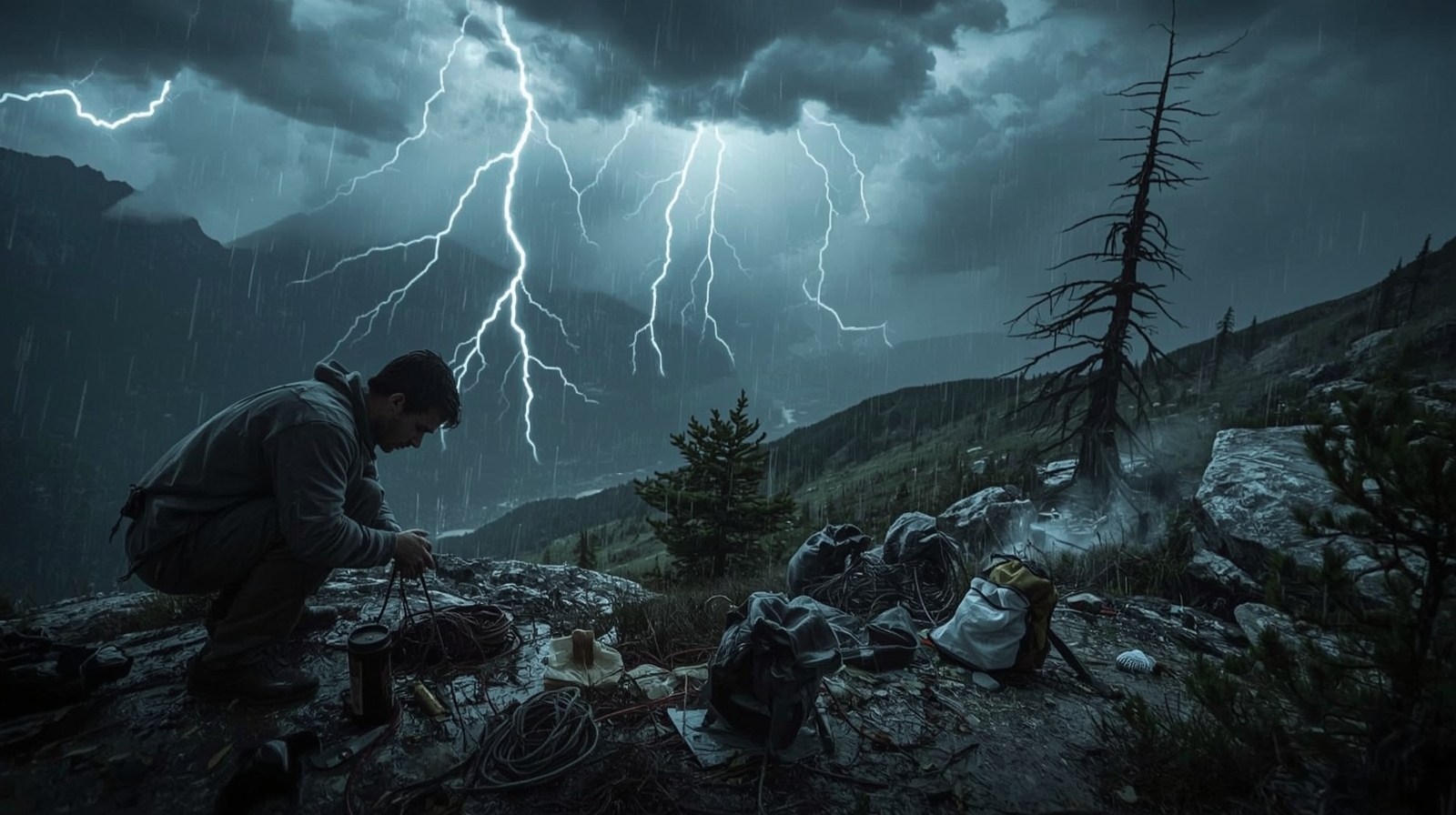
How Lightning Really Injures People Outdoors
Lightning safety in the wilderness is mostly about decisions you make before the first rumble. Once a storm is overhead, you’re reacting with limited options, limited time, and often limited communication.
Related Articles:
The good news is that lightning risk isn’t random. It concentrates around terrain features, weather timing, and group behavior. When you understand those patterns, you can choose routes, camps, and storm protocols that meaningfully lower exposure.
Direct strikes, side flashes, and ground current
A direct strike is the obvious one, but it’s not the most common mechanism in outdoor incidents. More often, people are injured by energy that travels through nearby objects and ground.
A side flash happens when lightning hits a taller object (like a tree) and part of the current jumps to you. This usually happens because you’re close enough to become a better pathway than the air gap.
Ground current is a major backcountry danger. When lightning hits the ground, energy radiates outward through soil and rock. If your feet (or hands and knees) are at different distances from the strike point, that voltage difference can travel through your body.
Why timing and distance matter more than you think
Many people wait until rain starts, then worry about lightning. That’s backward.
Lightning can strike miles away from the core of the storm, even when the sky above you looks only “threatening.” A practical rule is to treat the first sound of thunder as an immediate trigger to move to a safer position, not to “watch it a bit.”
If you can hear thunder, you’re within strike range.
For authoritative guidance on lightning safety basics and timing, see: NWS Lightning Safety.
Reading Storm Risk Before You Commit to Exposed Terrain
Once you know how lightning injures people, the next step is reducing your odds of being exposed when storms build. You don’t need to be a meteorologist to do that.
You just need a few repeatable habits before you step onto ridges, summits, open lakes, or big alpine basins.
Forecast cues that should change your plan
When the forecast mentions “isolated thunderstorms,” that often translates to fast-building cells that can surprise you above treeline. “Scattered thunderstorms” is usually worse for route planning because storms can pop up across a wide area and linger longer.
Look at the hourly forecast, not just the day summary. Pay attention to the time window for convection (often early afternoon in summer mountains). If your route includes a high ridge, you want to be off it before that window starts-not halfway along it.
A practical planning habit is to ask yourself: Where is my quickest descent if the sky changes in 15 minutes?
On-trail signs that lightning potential is rising
In the field, watch for cumulus clouds that stack vertically and darken at the base. A sudden temperature drop and gusty outflow wind can arrive ahead of the rain and lightning.
If you notice your hair lifting, hear crackling, or see small sparks around metal gear, treat that as an immediate emergency. Don’t wait for thunder.
Get off exposed high points and reduce your profile while moving toward safer terrain. This is one of those moments where decisive action beats perfect decision-making.
Terrain Choices That Reduce Your Lightning Exposure
Forecast reading helps you avoid exposure, but terrain choices are what protect you when the storm timing isn’t perfect. “Find shelter” is vague advice.
In the wilderness, the best you can do is choose terrain that reduces your chance of becoming the best electrical pathway.
Safer and riskier terrain at a glance
The goal is to avoid being the highest point and avoid places where current concentrates. That usually means leaving ridgelines, summits, and open flats, and moving toward lower, more uniform terrain.
Here’s a practical comparison you can use in real time:
| Terrain option | Relative risk | Why it matters | What to do there |
|---|---|---|---|
| Exposed ridge/summit | Very high | You’re the highest point; wind and strikes concentrate | Descend immediately; avoid traveling on the crest |
| Open meadow/plateau | High | No taller objects; ground current can spread widely | Move to lower ground; avoid isolated boulders |
| Dense, uniform forest (not the tallest tree) | Medium | Trees can intercept, but side flash is a concern | Stay away from single tall trees; don’t lean on trunks |
| Low point in a broad valley (not a drainage) | Medium to lower | Reduces “highest point” risk | Avoid wet channels; choose a gentle bench |
| Narrow gully/slot/overhang | Variable | Flooding, rockfall, and current paths can worsen | Avoid if water can rise or rock funnels exist |
Where lightning risk hides in “low ground”
Not all low points are equal. Avoid gullies that act like drainage pipes, especially if heavy rain is likely. Flash floods can become the immediate life threat.
Be cautious near cliff bases with wet streaks and seeps. Water increases conductivity, and a wet wall can encourage current flow.
If you can, pick a drier bench away from obvious runoff lines. Think “lower than the ridge,” not “lowest possible place water wants to go.”
Group Spacing and Communication During Thunderstorms
Terrain is only half the story. Many wilderness lightning incidents become multiple-casualty events because groups cluster under one “shelter tree” or huddle together when stressed.
A spacing plan works best when it’s decided before you need it.
How far apart should you spread out?
A workable approach is to separate people so one strike or one ground-current event is less likely to affect everyone. In practice, you’re balancing two needs: reducing shared risk while staying close enough to communicate and help.
If terrain allows, spread out so individuals are several body lengths apart. Avoid lining up in a straight line along a ridge or trail, because a single strike area can affect multiple people.
Also avoid creating one continuous conductive “system.” For example:
- Don’t tether yourselves with connected ropes during active lightning unless it’s required for immediate safety.
- Don’t huddle shoulder-to-shoulder under a tarp.
- Don’t let packs, trekking poles, or other gear bridge person-to-person contact.
Simple roles and signals that prevent chaos
Before storms are likely, assign roles:
- Storm watcher: tracks clouds, time, and thunder.
- Navigator: identifies the nearest safer terrain feature.
- Spacing lead: keeps the group moving together but separated.
Use short check-ins and clear commands like “spread,” “descend,” and “move off the crest.” In wind and rain, people miss subtle cues.
Quick reference: Your spacing plan should reduce the chance of multiple injuries, while still allowing immediate first aid if someone goes down.
Shelter Myths: Tents, Trees, Caves, and Rock Overhangs
Once your group is moving and spaced, you’ll still need to make “shelter” decisions. This is where lightning safety gets muddied by half-true rules.
A lot of shelter advice makes sense in cities, then fails in the backcountry where you don’t have grounded infrastructure.
Are tents safe in lightning?
A standard backpacking tent does not protect you from lightning the way a building does. It doesn’t provide a grounded metal cage, and aluminum poles do not “attract” lightning so much as provide a conductive path if lightning hits nearby.
If you’re already in camp when lightning starts, the tent can keep you out of wind-driven rain and reduce hypothermia risk. That matters.
But don’t treat the tent as lightning protection. Instead, stack the odds in your favor by choosing a campsite that’s not on the highest knob, not in an open field, and not next to a lone tall tree.
Trees, overhangs, and caves: when “cover” is dangerous
Standing under a single tall tree is a classic mistake because of side flash and ground current around the trunk. If you’re in forest, choose a lower, uniform stand rather than the biggest tree in the area.
Rock overhangs and shallow caves are tricky. If the opening is shallow and you’re close to the rock face, current can travel across wet stone.
Some overhangs also funnel water and wind, creating additional hazards. If you must use an overhang, move deeper only if it’s dry and you can stay away from walls, ceiling, and running water. If it’s a narrow slot, prioritize flood safety first.
What to Do When You’re Caught Above Treeline
Above treeline is where lightning decisions feel most urgent because you usually have limited descent options and very visible exposure.
Your best time to act is before the storm matures. Still, it helps to know what to do if you’re already committed to open terrain.
Fast descent without creating new hazards
If thunder begins and you’re on a ridge, descend promptly. Choose the lee side if it’s safer from wind, but don’t commit to unstable scree or cliffed terrain that could cause a fall.
A fall injury can trap you in exposure longer, which turns a lightning problem into a prolonged rescue problem.
If you’re roped as climbers, consider whether you can safely reduce contact and avoid a single-current pathway through the rope system. Avoid being clipped to metal cables or fixed hardware during active lightning.
The lightning “position”: when it helps and when it doesn’t
The crouched lightning position (feet together, crouched low, minimizing contact) is a last resort when you cannot reach safer terrain. It is not a magic shield.
If you use it, do so on a dry-ish insulating surface if available (like a pack) and keep your feet together to reduce step voltage.
Don’t lie flat. That increases your ground contact area and can increase current flow through your torso.
For additional medically oriented context and outdoor lightning injury prevention, see: CDC Lightning Safety.
Water, Wet Ground, and Fishing: The Hidden Exposure Multipliers
If you’re near water, lightning risk often rises because water and wet rock change how current moves. They also push you into open terrain like shorelines, boats, and exposed banks.
That means you may need to act earlier than you would on a forested trail.
Lakes, rivers, and shorelines during lightning
If you’re on a lake, get off the water early. Don’t wait for rain, and don’t assume the far shore is “close enough.” A small craft is essentially the highest object on a flat conductive surface.
On shore, avoid the immediate edge if it’s the highest open band. Move inland to lower, more uniform ground.
Also avoid standing on wet rock slabs near waterfalls and rapids. Slip risk is real, and conductivity is higher.
Fishing gear and metal tools: realistic risk management
Rods, poles, and metal tools don’t “summon” lightning from clear skies. The bigger issue is that they make you taller and can become part of a conductive path if lightning strikes nearby.
When storms threaten:
- Break down rods and stash them away from where people hunker.
- Lower long poles and avoid holding anything upright.
- Move away from exposed banks and isolated rocks.
Don’t hold a long graphite rod upright while scanning the sky. Graphite is conductive enough to matter, and the posture puts you at the wrong end of a bad equation.
Campsite Selection That Makes Lightning Decisions Easier
The easiest lightning emergency is the one you never have because your camp isn’t in a high-exposure zone.
This is where good terrain habits quietly pay off. A smart campsite won’t make you “safe,” but it often gives you better options when storms roll in.
Choosing a site with fewer lightning and wind problems
Avoid camping on the highest point of a basin, on exposed points, and on ridgelines-even if the view is tempting.
Look for a slightly lower bench or a gently rolling area where you’re not the tallest object. In forest, aim for a uniform stand of trees rather than an isolated giant.
Also consider widowmakers. Dead branches and leaning snags become dangerous in storm gusts. Lightning safety and wind safety overlap more than most people realize.
A practical campsite checklist you can reuse
Use this checklist when you’re tired and tempted to stop early:
- Stay off ridgelines, summits, and obvious high knobs
- Avoid lone tall trees and the tallest tree in a small cluster
- Don’t camp in dry streambeds or narrow drainages (flash flood risk)
- Pick ground that drains without channeling water through your tent
- Keep some distance from water edges on exposed shorelines
- Identify an “even lower” spot you could move to if thunder starts
If your site passes most of these, you’ll have better options when the sky turns.
Step-by-Step Lightning Protocol for Hiking Groups
Once you’ve chosen decent terrain and camp habits, a protocol keeps your group from debating in the rain. It also reduces the odds of someone making a solo “shortcut” decision.
You can tailor this to your terrain, but keep the logic consistent: act early, move down, spread out, and reduce contact with conductive pathways.
A simple decision tree you can remember
When you hear thunder or see lightning, run this sequence:
- Stop upward travel and stop committing to exposed terrain.
- Move off ridges and away from summits toward lower, uniform ground.
- Spread out so one strike is less likely to injure multiple people.
- Separate from tall isolated objects (trees, boulders, poles).
- Manage cold and wet exposure without pretending you’re “safe.”
This approach is intentionally conservative. In wilderness settings, it’s easier to relax caution if the storm passes than it is to undo a bad commitment to exposure.
Common mistakes that sabotage good intentions
One common mistake is trying to “finish the last 10 minutes” to the top or the pass. That often places you at the most exposed location exactly when lightning risk peaks.
Another mistake is bunching up for comfort. Groups huddle under one tree, share one tarp, or sit shoulder-to-shoulder.
If lightning hits nearby, that closeness can turn one injury into several. That overwhelms your ability to provide first aid and self-evacuate.
What to Do After a Lightning Strike in the Wilderness
Even with good planning, strikes can happen. When they do, clear priorities matter.
Lightning injuries can look confusing. Someone may appear “fine” and then deteriorate, while another person may look unresponsive but be resuscitatable with immediate action.
Scene safety, triage, and the myth of “electrified” victims
First, make sure you’re not putting more people into danger. If lightning is ongoing, spread the group and move to the best nearby safer terrain you can reach quickly.
A lightning victim is not “electrified.” You can touch them safely. That single fact saves lives because delays in care are deadly.
If multiple people are down, prioritize those who are unresponsive or not breathing. In lightning incidents, respiratory arrest and cardiac arrest can occur, and early CPR can be lifesaving.
First aid priorities and evacuation decisions
Start with airway and breathing. If someone isn’t breathing normally, begin CPR and use an AED if you have one (some guided groups carry them).
Treat burns as a secondary priority after life threats. Many lightning burns are superficial but can mask deeper trauma.
Next, look for trauma from blast effects and falls:
- Head injuries
- Fractures
- Spinal concerns
- Ruptured eardrums
Keep the patient warm and dry. Shock and hypothermia can complicate recovery even in summer.
If you have satellite messaging, send a clear, structured emergency report: location (coordinates), number of patients, consciousness/breathing status, major injuries, weather conditions, and your plan. Continue monitoring because arrhythmias and neurological symptoms can evolve over hours.
Quick reference: After a strike, you can touch the victim immediately, start CPR if needed, manage trauma, prevent hypothermia, and call for rescue with precise location details.
Advanced Tips: Managing Risk on Multi-Day Trips and Technical Terrain
Once you have the basics, the biggest gains come from planning and from reducing “commitment traps” where you can’t easily retreat.
This is especially true on multi-day trips, where fatigue and fixed itineraries can push you into bad timing.
Route timing, bailout points, and conservative summit strategies
Build your days so the most exposed terrain happens early. That might mean starting at dawn, shortening mileage, or choosing a lower objective on days with thunderstorm potential.
Mark bailout points before you need them. On a map, identify treeline transitions, low saddles that lead into safer basins, and trails that provide quicker descent.
When thunder starts, your goal is not to “optimize” the route. Your goal is to execute a pre-identified, simple escape option before the storm fully matures.