Building an Improvised Raft or Flotation Aid: Safe Construction and Ferry Techniques for River Crossings
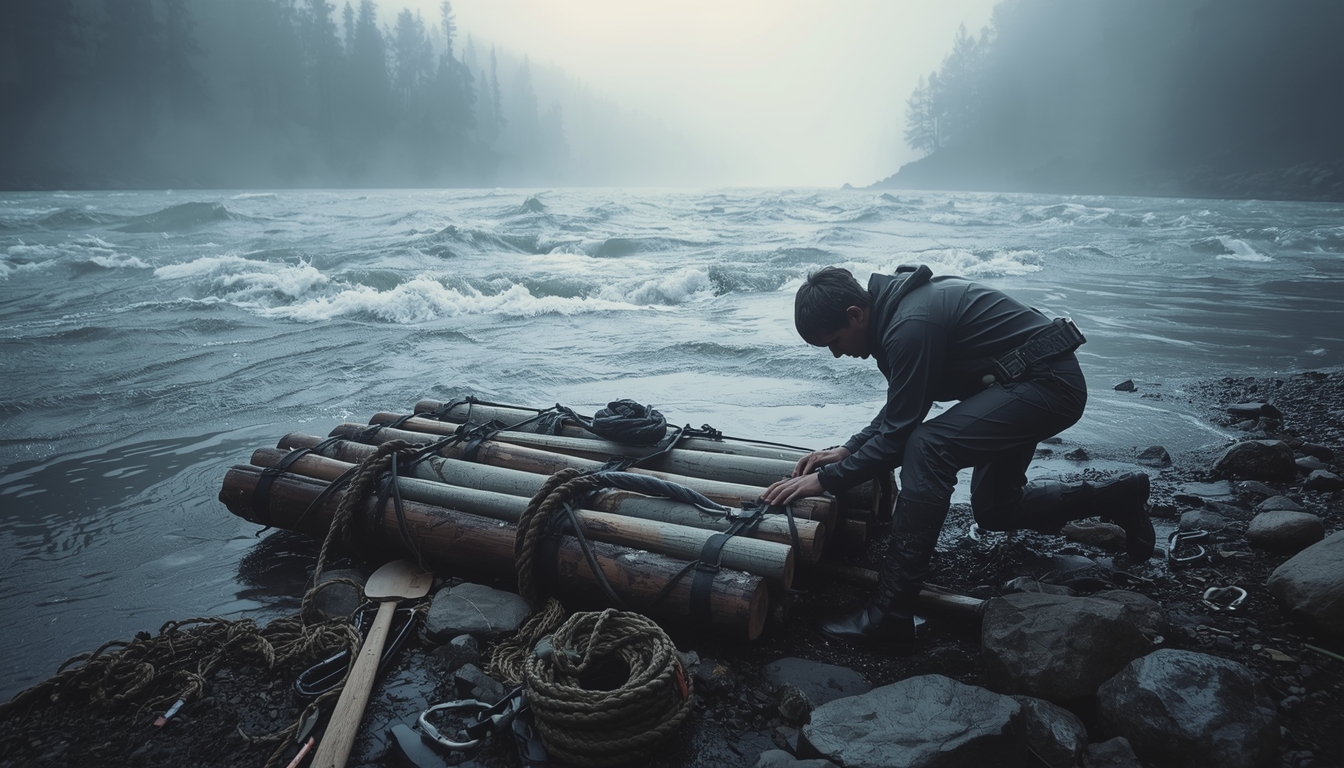
Deciding Whether a Raft Crossing Is the Right Call
Reading the River Before You Touch the Water
Before you start gathering materials, decide if you should be crossing at all. Moving water is deceptive: a river that looks “knee deep” can still knock you down if the bottom is slick and the current is fast.
Related Articles:
Start by scouting upstream and downstream. Look for hazards like strainers (downed trees), undercut banks, boulders that create hydraulics, and any visible whitewater.
Pay attention to what the river is telling you. Fast “V” shapes usually point downstream and often mark the main channel. Standing waves and boiling water can signal rocks, holes, or irregular depth.
If there’s any doubt, look for a calmer section. Wider, shallower stretches often run slower, and bends may hide deeper channels on the outside edge.
A quick reality check: if you can’t clearly identify a safe landing zone on the far side, you don’t have a crossing plan-you have a gamble.
When to Avoid Improvised Flotation Entirely
Improvised rafts are not a magic solution. Sometimes the safest “river technique” is waiting, rerouting, or turning back.
If the water is cold enough to cause cold shock or rapid loss of coordination, even a short swim can be life-threatening. The U.S. National Weather Service explains how quickly cold water affects breathing and function in its cold water safety guidance.
Also avoid improvised flotation if the river is rising, silty and fast after storms, or fed by snowmelt (often cold and pushy even when it looks calm). If you’re alone, your margin for error is smaller because rescue options are limited.
Warning: If the current is strong enough that you cannot stand and move sideways without bracing, a DIY raft is more likely to become an uncontrolled ride than a controlled ferry.
Picking a Crossing Site That Works With Your Build
If you do proceed, choose the crossing site before you build. Your raft or flotation aid should match the water, not the other way around.
Look for a straight section with a gradual entry and exit, minimal obstacles, and an obvious eddy or slack-water zone to land. A clean downstream “runout” (no strainers, no logjams) is a major safety feature.
Use local data when it’s available. River gauge height and discharge can help you identify rising water or abnormal flows. The U.S. Geological Survey publishes real-time data through USGS Water Data.
Think like a pilot: you need a launch zone, a flight path, and a landing zone. If any one of those is missing, don’t build yet-keep scouting.
Understanding Buoyancy and Choosing Field-Ready Materials
The Buoyancy Basics That Prevent Sinking and Rolling
You don’t need formal physics, but you do need one rule: your flotation must displace more water (by volume) than the total weight you’re trying to carry.
In practice, DIY builds fail less from “not enough float” and more from poor stability. Common causes include a platform that’s too narrow, a load stacked too high, or floats that shift under torque.
Aim for a low center of gravity. Spread weight wide, keep heavy items close to the deck, and avoid tall piles. If your raft looks like a stack, it will behave like a stack when current hits it.
Do a quick field test before committing. Set the raft in shallow water, load it with your pack, and press down hard on one side. If it wants to roll or the floats “burp” out from under the lashings, fix that now-not midstream.
Pro Tip: Build for stability first, then for speed. A slower, wider platform is usually safer than a narrow “fast” one.
Common Improvised Flotation Options (and Their Tradeoffs)
Your best materials are the ones that are:
- Watertight
- Easy to lash
- Resistant to puncture
Dry bags, pack liners, and heavy-duty trash bags can work as air bladders, but they must be protected from abrasion. Plastic jugs (water, detergent, fuel-style containers) are often more durable than people expect.
Closed-cell foam pads offer flotation even if punctured, which is a big advantage. If you have a sleeping pad, it can be part of the system, but don’t rely on a single inflatable pad as your only buoyancy.
If you’re thinking about logs, remember the tradeoff. Logs float, but log-rafts are heavy, slow to build, and harder to control. In many real scenarios, a pack float (your pack plus added sealed air) is faster and less complex.
Comparison Table: Fastest-to-Deploy Flotation Materials
Use this as a quick decision tool when you’re choosing what to build with on the bank.
| Material | Buoyancy Reliability | Puncture Resistance | Ease of Lashing | Best Use Case |
|---|---|---|---|---|
| Sealed plastic jugs | High | High | Medium | Quick raft sides or outriggers |
| Closed-cell foam pad | Medium | Very high | High | Deck flotation, side stability |
| Dry bags filled with air | Medium to high | Medium | High | Lightweight float bags, pack raft aid |
| Heavy trash bags (double bagged) | Low to medium | Low | Medium | Backup air bladders only |
| Logs/poles | Medium | High | Medium | Frame + some buoyancy, slow water |
Pros of jugs + foam + poles: easy to inspect, predictable, and stable when spread wide.
Cons: bulkier lashing points, and you must prevent jugs from slipping out under torque.
Safe Construction: Layouts, Lashings, and Load Control
A Simple, Stable Design You Can Build Without Specialized Gear
For most hikers, the safest improvised option is a low platform with two “float rails” and a tied-down load. Picture two parallel bundles of jugs or inflated dry bags, connected by poles or sturdy branches as cross-members.
Your pack rides low in the middle, not stacked on top. That single choice (low load, centered) does more for stability than most “upgrades.”
If you have trekking poles, paddles, or straight branches, you can create a ladder-like frame: two long rails with multiple short cross pieces. Then lash flotation to the outside of each rail.
This catamaran style resists rolling better than a single center float. Keep the overall width generous; width buys you forgiveness when your angle or timing isn’t perfect.
Lashings That Don’t Slip When Wet
Lashings are the difference between “floats attached” and “floats attached after the first wave.” Choose cordage that bites: accessory cord, paracord, webbing, or even torn fabric strips twisted into flat ties.
Avoid slick line that loosens when soaked. Prioritize friction and redundancy by using multiple wraps and backup tie-offs.
If you’re not confident in your knots, don’t overcomplicate it. Several tight wraps plus multiple half-hitches is usually better than one fancy knot you can’t inspect.
Construction checklist:
- [ ] Build the frame first (rails + cross-members)
- [ ] Attach flotation evenly on both sides
- [ ] Add a center “deck” layer (foam pad, spare clothing in bags, or branches)
- [ ] Tie your pack down low with at least two independent lines
- [ ] Add a control line (long rope) only if you can manage it safely
Warning: Avoid tying yourself to the raft. If it pins or flips, you want separation-not entanglement.
Weight Placement and Waterproofing That Prevents a Bad Surprise
Assume something will get wet. Even if your raft performs perfectly, splashes, dips, and sudden pivots are normal in current.
Line your pack with a trash compactor bag or pack liner. Double-protect essentials like insulation and fire-starting materials.
Place dense items (water, cookware, food) in the center and as low as possible. Put lighter, bulky items on top, and lash anything that can swing.
Before launch, do a quick “shake test.” Grab the raft and simulate a lateral tug. If the pack shifts on land, it will shift more aggressively in moving water.
Personal Preparation and the First Steps of Ferry Planning
Dressing and Prepping Your Body for Cold-Water Consequences
Even in mild weather, river water can be cold enough to trigger a gasp reflex and instant breathing disruption. That’s why your clothing choices matter as much as your raft.
If you have a rain shell, wear it to cut wind after the crossing. If you have insulating layers, keep at least one dry and sealed.
Think through what happens if you swim. Can you self-rescue to the nearest bank? Can you keep your airway clear? If not, don’t commit to a crossing based on “it’ll probably be fine.”
The CDC outlines how quickly cold exposure becomes dangerous and what hypothermia looks like in its hypothermia information.
Also remove snag hazards. Unclip sternum straps, loosen hip belts, and make sure you can ditch your pack quickly if it drags you down.
Setting Roles, Signals, and a Recovery Plan
If you have a group, define roles in plain language. Clear roles reduce confusion right when you need precision.
A simple setup works well:
- One person manages the raft.
- One person watches downstream for problems.
- One person stays ready with a throw line or long pole (if you have one).
Pick signals you can understand over water noise:
- One arm up = stop
- Two arms waving = emergency
- Pointing = intended landing
Agree on a “miss plan,” too. If you miss the landing eddy, where is the next safe bank? Identify it before you launch.
On the far side, plan how you’ll pull the raft out quickly. A raft that drifts back into current while you reorganize gear creates a second hazard after you think the hard part is done.
Starting Ferry Thinking: Angle, Current, and Where You’ll End Up
A controlled river crossing is rarely a straight line. Even with a raft, you should expect downstream drift.
This is where basic ferry thinking begins: you aim upstream of your target landing so the current carries you into it. Stand on the bank and pick three points:
- Your launch
- Your intended landing
- An “acceptance zone” downstream that is still safe
If your raft can’t track predictably in shallow water near the edge, it won’t suddenly become controllable midstream. Next, it’s time to make ferry angles and eddy use more deliberate.
Ferry Angles and Eddy Use for Controlled Crossings
Setting a Ferry Angle That Actually Gets You to the Landing
A ferry is controlled drift. You point the raft slightly upstream so the current pushes you sideways toward your target instead of washing you straight downstream.
The easiest way to set this up is to start in slack water (an eddy). Aim your bow about 10-30 degrees upstream of the landing.
Make small corrections early. In the first third of the crossing, tiny angle changes have a big effect because you still have time and room to drift.
Midstream is the wrong time to “fix it” with big movements. That’s when rafts get broadside and flip.
A practical example: if your target is a gravel bar, pick a spot 20-50 feet upstream of it as your visual aim point. If you notice you’re arriving too high (upstream), reduce your upstream angle slightly and let the river do more of the work.
Using Eddies to Launch, Pause, and Brake
Eddies are your friend because they give you control and a plan B. Before you launch, look for an eddy line: the seam where smooth upstream-moving water meets the downstream current.
You can often see it as a change in texture or a thin line of bubbles and debris.
Use eddies for three specific jobs:
- Stage: set the raft in slack water and re-check lashings and load security.
- Hop: if the river is wide, ferry from one slack zone to the next rather than committing to one long crossing.
- Brake: as you approach the far bank, angle slightly downstream so the current slides you into the eddy rather than pinning you against shore.
If you get nervous mid-crossing, don’t freeze. Look for the nearest eddy you can move into, even if it’s not your intended landing.
Staying Stable While You Move the Raft
Where You Sit or Kneel Matters More Than You Think
Improvised flotation gets unstable fast when your weight goes high or shifts suddenly. If you’re riding the raft, kneeling is usually safer than sitting tall because it lowers your center of gravity and lets you brace.
Keep your knees wide, your hips low, and your hands on the frame (or a secure lashing point). Those small contact points add up to real stability.
Avoid standing unless the water is extremely calm and your platform is wide and rigid. Standing turns small wobbles into bigger ones, and it slows your reaction time.
If you’re not riding the raft and instead you’re pushing or swimming it across, stay upstream of it. That way, if it surges or catches current, it moves away from you rather than over you.
In shallow water, walk it along the edge first to confirm it tracks straight and doesn’t “crab” sideways.
Warning: Never wrap a control line around your wrist or tie it to your body. If the raft catches on a rock, you want to be able to let go instantly.
Simple Propulsion Options That Work with Improvised Builds
You don’t need perfect paddle strokes, but you do need a way to correct your heading.
The simplest method is a hand paddle: flat hands, slow strokes, and short corrections on the side you want to turn away from. It’s not efficient, but it’s often enough to hold a ferry angle.
A pole is better than a paddle in shallow water, but only if the bottom is firm. Plant the pole slightly upstream of your body, push smoothly, and let it slide rather than stabbing.
Stabbing can jam the pole and spin the raft broadside.
If you have a trekking pole, treat it gently. Use it more like a rudder than a push pole: drag it on one side to steer, especially near the landing when you need fine control. If you built a wide catamaran-style raft, steering corrections will feel slower-start them earlier than you think.
Rope-Assisted Crossings Without Creating New Hazards
When a Rope Helps and When It Makes Things Worse
A rope can give you control, but it can also create entanglement, pinning, and sudden load forces you can’t manage.
Use a rope only if you have enough space, enough people, and a clean downstream runout with no strainers. If the river corridor is full of brush, logs, or boulders, a rope is more likely to snag than assist.
Be honest about strength and friction. A loaded raft in current can generate forces that surprise you, especially if it gets sideways.
If you wouldn’t feel confident holding the full weight of the raft and pack while someone yanks hard on the other end, don’t plan a rope system that requires it.
A good field rule: if the rope is your only plan to prevent a bad outcome, you’re probably past the point where you should be attempting the crossing.
Safer Rope Setups: Tag Lines, Belays, and Quick Releases
The safest rope use for most improvised crossings is a simple tag line for retrieval, not a tight “zip line” across the river.
Tie a line to the raft with a quick-release knot. Keep the rope coiled and actively managed, and let it pay out without tangling around feet or brush.
Your goal is to pull the raft back if you abort, not to hold it in the main current.
If you have enough people for a managed system, use a downstream belay concept. Position a handler downstream on the near bank (or in a safe eddy) so the rope angle naturally pulls the raft toward shore if it drifts.
Keep the line low, avoid loops, and set a clear “drop it” signal.
For groups, a practical sequence is:
- Send the raft across with minimal load first.
- Then send heavier loads.
- Send people last.
That order reduces the chance you’ll deal with a rescue while also protecting the most critical gear.
Mid-Crossing Adjustments and Controlled Landings
Fixing Yaw and Avoiding the Broadside Problem
Yaw is the slow rotation that turns your raft sideways to the current. Sideways is where trouble starts because the current pushes hard on the raft’s widest face.
The fix is simple in concept: correct early, with small inputs.
If your bow starts to swing downstream, steer toward the swing before it becomes a full broadside. Use short strokes or a dragging pole on the downstream side to bring the bow back upstream.
If you wait until you’re fully sideways, you’ll need more force than you can usually generate with improvised paddles.
If you can’t correct and you have a safe eddy downstream, shift from fighting the river to choosing the best landing. A controlled miss beats an uncontrolled flip.
Landing Without Getting Surfed Back into Current
Landings go wrong when you approach too fast, hit the bank broadside, or step off and immediately lose balance.
As you near your intended eddy, reduce your upstream angle and let the current slide you in. Think of it like merging into a slow lane rather than ramming the shoulder.
Once you’re in slack water, keep one person controlling the raft while the others unload. Don’t stand up and reorganize gear while the raft is still half in current.
Drag it fully onto shore or secure it to something solid before you loosen lashings.
With the basics of ferrying and landings covered, the next step is dealing with real-world failures: shifting floats, frame flex, and midstream surprises.
Troubleshooting Problems Before They Become Emergencies
When Flotation Shifts, Leaks, or Starts Riding Uneven
If one side of your raft suddenly sits lower, assume something moved or lost air. Your first move is not to muscle through mid-current.
Instead, steer for the nearest slack water you can reach, even if it means taking an alternate landing. Once you’re in a calm pocket, do a fast diagnosis.
Check common failure points:
- A jug lid loosened
- A dry bag valve cracked open
- A lashing slid toward the center and squeezed the float bundle
If the issue is a puncture, don’t waste time trying to fully repair it on the water. Redistribute buoyancy by moving intact floats to the low side, then re-tighten the load.
Build in redundancy so one failure isn’t catastrophic. Two smaller float rails are usually easier to rebalance than one large center float, and multiple independent lash points keep a shift from turning into a full separation.
| Symptom | Likely Cause | Best Immediate Fix |
|---|---|---|
| One side rides low | Float slipped inward or partially deflated | Get into slack water, re-center float, add backup wraps |
| Bow plows water | Pack slid forward or water pooled on deck | Reposition load aft, add drainage gaps, re-tighten pack tie-downs |
| Sudden yaw to one side | Unequal drag from a loose float or dangling strap | Trim loose ends, re-secure flotation, correct angle early |
Frame Flex, “Tacoing,” and Load Creep Under Current Pressure
If your raft bends in the middle (the classic “taco”), your rails are likely too thin, your cross-members are too few, or your load is too concentrated at the center.
The danger is that flex changes how the raft meets the current, which can trigger a broadside turn you can’t correct.
The best fix is structural, not heroic paddling. Add at least one more cross-member near the center and one near the bow, then lash them with more wraps than you think you need.
If you have the option, use thicker poles for the long rails and reserve thinner branches for short cross pieces.
Load creep is the quieter version of the same problem. If your pack slowly migrates to one side, you’ll feel like the raft is fighting you.
To stop it, run two tie-downs in opposing directions:
- Front-left to rear-right
- Front-right to rear-left
That crisscross pattern keeps the load from walking.
What to Do When Something Goes Wrong Mid-Crossing
If You End Up Swimming: Your First 10 Seconds and Your Next 60
If you fall in, your first job is breathing-not gear. Cold water and surprise both trigger a gasp reflex, so force a controlled exhale and get your face clear.
Next, orient yourself on your back with feet up and pointed downstream if you’re in current. This helps you see hazards and reduces the risk of foot entrapment.
Don’t chase the raft immediately if it pulls you into faster water. Instead, angle your swim toward the nearest safe bank or eddy using strong, deliberate strokes.
If your pack is on you and starts dragging you down, ditch it. You can replace equipment, but you can’t replace time in cold, moving water.
Once you’re out, shift immediately to rewarming and accountability. Get wind off you, change into a dry layer if you protected one, and evaluate hands and coordination before attempting a second crossing.
The National Park Service has a clear overview of moving-water hazards in its water safety guidance.
Pins, Strainers, and Why “Let Go” Is Often the Correct Move
A pinned raft happens when current pushes the platform against a rock, log, or bank feature and water pressure locks it in place.
Your instinct may be to pull harder with a rope or lean on it from upstream. That can make the pin worse and can trap you between the raft and the obstacle.
If you feel the raft hesitate and start to load up against something, prioritize separating yourself from the system:
- Let go of control lines
- Avoid stepping into fast water near the obstacle
- Move to shore if you can
If the raft is pinned but you’re safe, you can often recover it later by changing the pull angle from downstream or unloading it first.
Strainers are even less forgiving. If you see downed trees, brush piles, or logjams in the corridor, treat that as a hard stop on the entire plan.
An improvised raft that drifts into a strainer can break apart and hold you underwater. Prevention is the move: choose a crossing zone with a clean downstream runout, even if it adds distance.
Making the Next Crossing Safer and More Predictable
Skill-Building and a Minimal “Crossing Kit” That Pays Off Fast
The most effective upgrade you can make is practice when the consequences are low. If you can, rehearse ferry angles and eddy entries on mellow water with a real boat.
You can also learn a lot by wading at the edge and watching how current lines move. That experience translates directly to better decisions when you’re tired, cold, or under time pressure.
For gear, you don’t need a dedicated packraft to get safer. A small crossing kit can improve your options:
- 30-50 feet of quality cord
- A compact roll of repair tape
- Two lightweight carabiners (for managing lines without tangles)
- One heavy-duty trash compactor bag (pack lining)
- One spare dry bag (flotation or storage)
If you travel in areas with frequent crossings, consider pre-rigging your pack so it can become a controlled float. Keep cord accessible, store inflation-capable bags where you can reach them fast, and bundle lash points so you’re not searching with numb hands.
A Final Decision Checklist You Can Use on the Bank
By the time you’re building an improvised raft, you’re already in a higher-risk scenario. A checklist helps you slow down and catch the obvious problems before they become irreversible.
Final bank checklist:
- [ ] I have a clearly identified launch, flight path, and safe landing, plus a downstream miss option.
- [ ] The raft sits level when loaded, and the load cannot shift side-to-side or front-to-back.
- [ ] Any rope in use has a quick-release attachment and is being actively managed (no loose coils near feet).
- [ ] I can ditch my pack quickly, and I am not tied to the raft.
- [ ] The downstream corridor is free of strainers, logjams, and unavoidable hazards.
Quick summary: Your best outcomes come from conservative site selection, redundant flotation, and early corrections. If any part of the plan relies on “we’ll figure it out midstream,” treat that as a sign to wait, move, or turn back.
If you want a practical next step, pick one improvement you can make before your next trip. Add a small cord-and-tape kit, practice basic ferry angles in safe water, or commit to more scouting time before you build.
Those small habits are what make improvised crossings less improvised in the ways that matter.